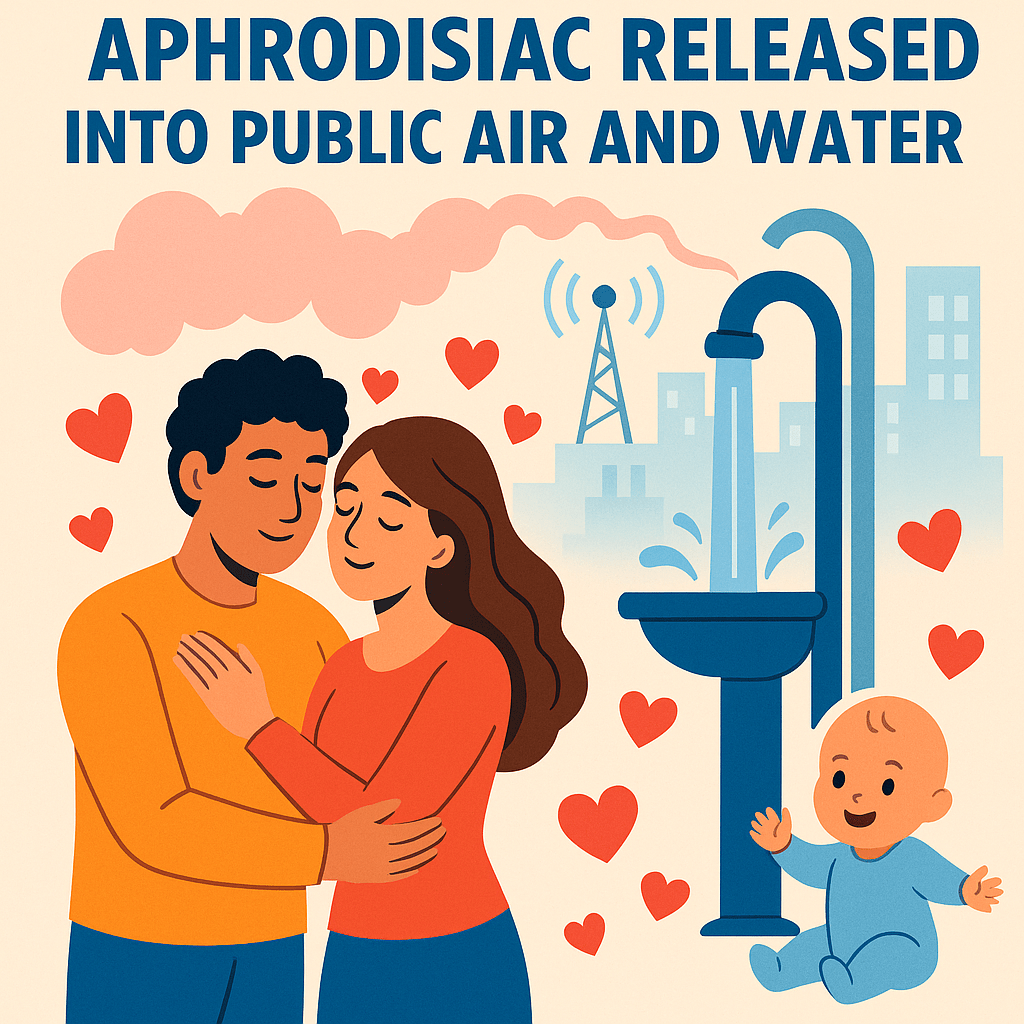
Let’s explore the hypothetical, openly and responsibly, as if humanity had collectively chosen to solve declining birth rates not by coercion or deception, but by chemical encouragement, with full consent and public knowledge.
In such a scenario, the goal would be to increase libido, bonding, romantic inclination, and perhaps even the idealization of parenthood. While no single chemical can directly make people “want babies,” certain known substances do nudge the body and brain toward sexual and reproductive behavior. Here’s a structured breakdown of candidate compounds that might be hypothetically dispersed (again, only with ethical oversight and public agreement):
1. Oxytocin (the “love hormone”) – Vapor or Misted Inhalant
Natural role: Released during intimacy, childbirth, and bonding; fosters trust, connection, and affection.
Effect if inhaled: Studies show that oxytocin can be absorbed intranasally and may increase eye contact, emotional bonding, and even sexual desire in certain settings.
Delivery method: Hypothetically, a fine mist in air-conditioned environments, or through nasal sprays voluntarily used in public places.
Warning: Effects are subtle and context-dependent. Without a social or emotional context, it may do little.
2. Pheromones – Airborne Compounds
Types: Androstadienone (male-associated), Estratetraenol (female-associated)
Effect: These compounds have shown minor but measurable effects on mood, perceived attractiveness, and sexual readiness in some controlled studies.
Delivery method: Airborne dispersal in limited, enclosed environments like clubs or theaters (where romantic interaction is socially acceptable).
Limitations: Human pheromones are debated in science; effects are less pronounced than in insects or animals.
3. Dopamine Agonists – Water or Air Additive (High Risk)
Effect: Dopamine governs motivation and reward; slight increases could make people more impulsive, adventurous, or romantic.
Candidate: L-DOPA (too strong), or more subtle plant-derived dopamine precursors like Mucuna pruriens.
Concern: Excess dopamine can cause mania, risk-taking, or even psychosis if unregulated.
4. Natural Aphrodisiacs – Tea, Beverage, or Infusion
Examples:
Maca root – boosts libido, fertility
Tribulus terrestris – testosterone support
Ginseng – energy, sexual performance
Delivery: Public infusions in beverages, teas, or supplements, clearly labeled and marketed.
Effect: Subtle elevation in sexual desire, possibly paired with social encouragement campaigns.
5. Mild Serotonergic Agents – Reduce Anxiety, Encourage Touch
Candidate: Microdoses of MDMA-like compounds (again, only hypothetically in a post-legal future).
Effect: Heightened emotional openness, love, decreased social fear.
Danger: Neurotoxicity at high doses, legal restrictions, and moral concerns over altering free will.
Additional Strategies (Non-Chemical but Complementary):
Environmental Design: Lighting, music, scent, and temperature all affect libido. Use warm lighting, rhythmic music, vanilla or sandalwood diffusers.
Symbolic Priming: Images of families, babies, and love subtly boost parenting desire — a psychological effect known as concept priming.
Spiritual Framing: If the concept of family and children is restored to its sacred and divine pedestal (as it is biblically), people will pursue it with joy instead of delay.
Philosophical Questions to Consider:
If love can be induced chemically, is it still love?
If society votes to biologically guide behavior toward fruitfulness, are we imitating God’s command to “be fruitful and multiply” (Genesis 1:28), or manufacturing it?
Would a world filled with artificially induced desire eventually lose its hunger for genuine connection?
Final Thought:
Imagine a nation that says to its people, not “We command you to bear children,” but rather:
“We have opened the airways of romance, filled the fountains with joy, and called back the garden where love once bloomed. Come, walk in it again, not as slaves to instinct, but as dancers in the song of life.”
Would you drink from that fountain, if it were sweet? Would you trust your heart, if it was lifted by wind, not from within?
 brikorn.com - Website of Brian Korn
Leave a comment