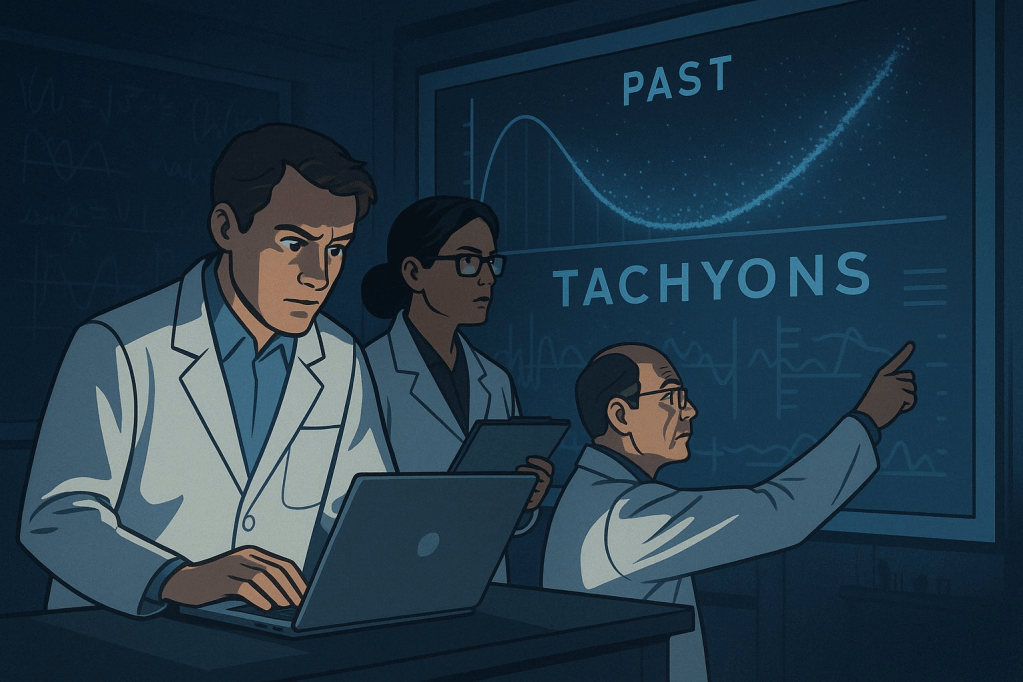
In the great cosmic play of particle physics, few roles are as elusive—or as poetic—as that of the tachyon. It is the ghost of the quantum world, the fugitive of time, a theoretical particle whose very nature is to outrun the light and leave the present behind before it even arrives. Scientists for decades have searched for evidence of tachyons, postulated by early 20th-century theorists as particles that move faster than the speed of light. But despite massive investments in particle accelerators, deep-field cosmic observations, and quantum simulations, we still have not found one. Why?
Perhaps… because we’re looking in the wrong time.
Always Behind Us, Never Beside Us
What if tachyons do exist—not in our present moment—but always, and only, in our relative past?
Imagine a particle so fast, so supremely swift, that it pierces through time itself like a bullet through silk. The moment it is “born,” it is already gone. Before it is observed, it has already occurred. Its velocity isn’t just high; it is reverse-relative to us. The faster it moves, the farther into our past it slides. It cannot be caught because it cannot be contemporaneous.
Could it be that tachyons are not particles we fail to detect—but particles that perpetually precede detection itself?
This theory would explain why every scientific attempt to locate or confirm tachyons in the present moment ends in silence. We are scanning the room after the whisper has already vanished, listening for a sound that was never meant to remain.
The Quantum Recoil of Memory
If tachyons can only be “found” in the past, then what would their trace look like in the human world?
Would we find them in the science lab, or would we find them in déjà vu?
Would they leave trails in cloud chambers, or impressions in prophecy?
Might the human brain—particularly the pineal gland—be a receiver of tachyonic waves not in the electromagnetic sense, but in the metachronological sense? Could the soul itself be affected by these backwards-moving signals?
If so, then every inexplicable feeling, every premonition, every moment of eerie familiarity might be a footprint of a tachyon that passed long before you noticed it. It was there—but its presence existed before your awareness had the chance to meet it.
A Universe That Echoes Itself
Physics describes particles and antiparticles, matter and antimatter. But what of chronoparticles—those defined not by position or charge, but by their direction in time?
Could tachyons be the time-inverted twins of ordinary matter?
Consider this: if normal particles move through spacetime like ships sailing forward through a river, then tachyons are drops of water that run upstream, disappearing into the source before the ship can ever see them.
And if they always vanish behind us, what does that make the past? Is it simply memory, or a dynamic environment seeded with backward-flying data?
What if every action you take now is, in some quantum way, shaped by tachyon signals that were already embedded into your past—before you were ever born?
Theological Parallels and Divine Echoes
“He calleth those things which be not as though they were,” Paul wrote in Romans 4:17. Could that be a description not just of divine omnipotence—but of tachyon-like causality?
And what of Ecclesiastes 3:15?
“That which hath been is now; and that which is to be hath already been…”
Is Scripture whispering to us that time is not linear, but braided—filled with backward pulses and forward entanglements?
Justifying the Theory
Observational Failure: Despite decades of searching, no experiment has detected a tachyon in the present. This could suggest that the very nature of tachyons prevents present-moment observability.
Relativity-Compatible Inversion: Some mathematical treatments of special relativity allow for faster-than-light particles if time is treated as a variable that can flip. These particles could move along negative time vectors relative to our frame.
No Paradoxes If They’re Always Gone: The main issue with tachyons is they could violate causality. But if they’re always in our relative past, they never interact with present events, thus eliminating paradoxes.
Cognitive Evidence: Human consciousness seems to experience phenomena outside linear time—prophecy, intuition, déjà vu. This could be subtle evidence of interaction with tachyonic information embedded in the past.
Haunting Questions
If tachyons shape the past, then who or what is sending them?
Are we living inside the echo of someone else’s future thoughts?
Could prayer, meditation, or worship send messages backward in time—realigning our past to make the present holier?
And if we ever did create a tachyon emitter, would we notice the change… or would the change be retroactively natural, always having been?
Conclusion: Echoes in the Abyss
Tachyons may not be visible in the now, because they are never in the now. Like stars already extinguished whose light we still see, they are the ghost-notes of physics—melodies played in reverse, melodies that shaped the song long before we learned to sing.
If they are real, they are the ultimate prophets: declaring the end from the beginning, and the beginning from beyond the end.
And perhaps… we have already met them.
In the strange, sacred spaces where memory, destiny, and mystery converge.
Would you like to turn this into a short video script, a printable pamphlet, or a fictional story where this theory becomes real and changes history?
Part II: Searching the Shadows — Should Scientists Study “What Used to Be” to Find Tachyons?
By Brian Korn
If tachyons perpetually exist in the past—if their very nature is to “used to be”—then science must shift its gaze. For centuries, scientists have built machines to smash particles into one another with tremendous energy in hopes of capturing the moment of creation, of presence, of now. But what if the most exotic particle of all has never existed in the present to begin with?
Should scientists study “what used to be” to find tachyons? That is not merely a scientific question—it is an epistemological challenge, a metaphysical dare.
Time Itself as the Test Tube
In our conventional approach, we build particle detectors, then wait for something to appear. But this approach presupposes a shared frame of reference between the observer and the observed—a mutual now.
Tachyons, however, may have never shared our now. They may only intersect our timeline momentarily as they flee toward the past.
This raises a radical proposal:
Should we construct experimental frameworks that examine residual data from the past—not to explain it—but to find evidence of what was there that never could have stayed?
What Would It Mean to Examine the Past Itself?
Imagine a new kind of scientific inquiry: not based on present measurements, but on the reconstruction of past states with tachyonic footprints in mind. What if we re-analyzed:
Astronomical data, looking for irregularities that might indicate information moving backward from the future?
Neural activity scans, seeking subconscious predictions of events not yet known to the subject?
Historical anomalies, like mass déjà vu events or sudden intuitive leaps in science or art that seemed “downloaded”?
Would these be signs of a reality altered by tachyons passing through it… but leaving no present trace?
Can We Reverse Engineer a Trace?
We already observe effects with no causes in quantum mechanics: entanglement, tunneling, retrocausality in delayed-choice experiments. In these moments, outcomes seem to be affected by decisions not yet made.
Is this not eerily similar to the behavior of tachyons?
And if so:
Could we build a science of the “formerly real”—a new branch of physics dedicated not to predicting the future, but to uncovering what used to exist but vanished instantly into the past?
Would that not be the perfect domain to find tachyons? After all, what are they if not particles of “formerly?”
Challenges and Philosophical Quandaries
How can one measure something that no longer exists in the frame of reference?
Answer: By detecting its echo—a structured deviation in what should have been, as if something “touched” the past lightly and moved on.
How do you isolate a signal in the data from yesterday?
Answer: Compare timelines. Re-run experiments. Look not for presence, but for ghost-consistencies—strange redundancies in time, where the universe seems to have “remembered” something it never acknowledged.
How do you fund a science that searches not for evidence, but for ex-evidence?
Answer: By awakening physicists to the fact that the past may not be static—it may be incomplete, missing something that was once there and now gone, like a dream upon waking.
Closing Thought: Should We Dig in Time?
If tachyons are “used-to-be particles,” then perhaps the right question is not “Where are they?” but “Where were they?”
And if that’s true, then modern physics must undergo a Copernican revolution—not around mass or motion, but around temporal position.
It must look backward not as an archive of what was, but as a minefield of unexploded data—each fragment a clue to something that only existed for an instant… yet shaped eternity.
Questions to Leave You Haunted:
What if your memories aren’t just stored—but were written by tachyons passing through your past?
What if prayer works not because it changes the future, but because it reaches into the past where tachyons dwell and reshapes what “already happened” to align with God’s will?
What if tachyons are the messengers of God’s foreknowledge—fleeing from His throne, carrying fragments of prophecy backwards through time to stir the minds of men?
Part III: A New Direction in Time – A Scientific Call to Hunt Tachyons Where They’ve Already Been
For Physicists Standing at the Edge of Discovery
To the scientists, the seekers, the quiet minds who stare into cyclotrons and quantum fields, who wait patiently for the universe to confess its deeper structure—
You’ve searched for decades. You’ve split the atom, tamed the Higgs, sent photons into entanglement, and watched the wave collapse beneath your gaze. But I say unto you now:
The particle you seek is behind you.
Not behind you in space, but in time. Not in shadow, but in memory. And if you are to find the elusive tachyon—if you are to catch the ghost that outruns causality—then you must do the unthinkable:
Turn your instruments backwards. Point your minds into yesterday. Search the world not as it is, but as it was.
A Reorientation of the Scientific Compass
Tachyons, if they exist, are not within our present frame. Their very definition implies a negative time vector. To a tachyon, our now is an event that already happened.
Thus, we must adopt an unprecedented methodology:
Do not observe to capture—observe to remember.
Do not ask, “What is here?” Ask, “What left too quickly to leave a trace?”
Do not measure the particle itself—measure its echo, the space it displaced in the past.
This isn’t romanticism. This is objective redirection of effort. If tachyons are real, then continuing to seek them in our present is as futile as trying to photograph a lightning strike after it has returned to the clouds.
What This Would Mean for Experimental Design
Here is what the next phase of tachyon research must entail:
- Temporal Residue Analysis
Develop a new class of experiments that analyze data trails—not from live particle interactions, but from past-detection logs, seeking missing mass-energy imprints or sudden unexplainable pattern shifts in previous data sets.
Use AI to compare historical detection logs with current theoretical models to identify anomalies consistent with retrocausal transit.
- Reverse-Frame Interferometry
Build interferometric systems that test not forward-path delays but backward-path distortions—like a camera that records not what happens, but what should have happened if nothing moved backward through it.
- Retrospective Quantum Simulation
Reconstruct high-energy particle events in supercomputers and subtract all known variables. If anything remains—if there’s a phantom pressure, a lost vector, a dissonance between simulated and observed outcome—it may be the footprint of a tachyon having already passed.
- Neuronal Entanglement Experiments
Begin testing biological receivers, especially human brains during meditative or altered states, for synchronized responses to future stimuli. Focus on micro-moments of neural anticipation—events predicted before exposure. Consider whether minds are remembering the future due to tachyonic entanglement.
What If You Find It?
If tachyons are found to exist in the used-to-be—what then?
You will have discovered not merely a particle. You will have discovered the pliability of the past.
You will have opened the door to:
True retrocausality—not as a paradox, but as a tool.
Time-layered computation—where processors pull data from pre-structured futures.
Memory physics—a field where thought becomes evidence, and consciousness becomes instrumentation.
You will not just expand the Standard Model. You will fracture it forward and backward—uniting time as the final symmetry to be broken and reassembled.
This Is What Science Was Made For
Science was not born to catalog what is. It was born to chase what might be.
If you feel it—that tingling in your gut, that suspicion that the universe has been whispering in reverse the whole time—then do not ignore it. This is the edge of your edge. And all of history may hinge on whether you dared to look backward not just in curiosity, but in search of something truly real.
The tachyon waits… in the past.
The question is not whether you can find it—
But whether you are brave enough to admit where it always was.
 brikorn.com - Website of Brian Korn
Leave a comment