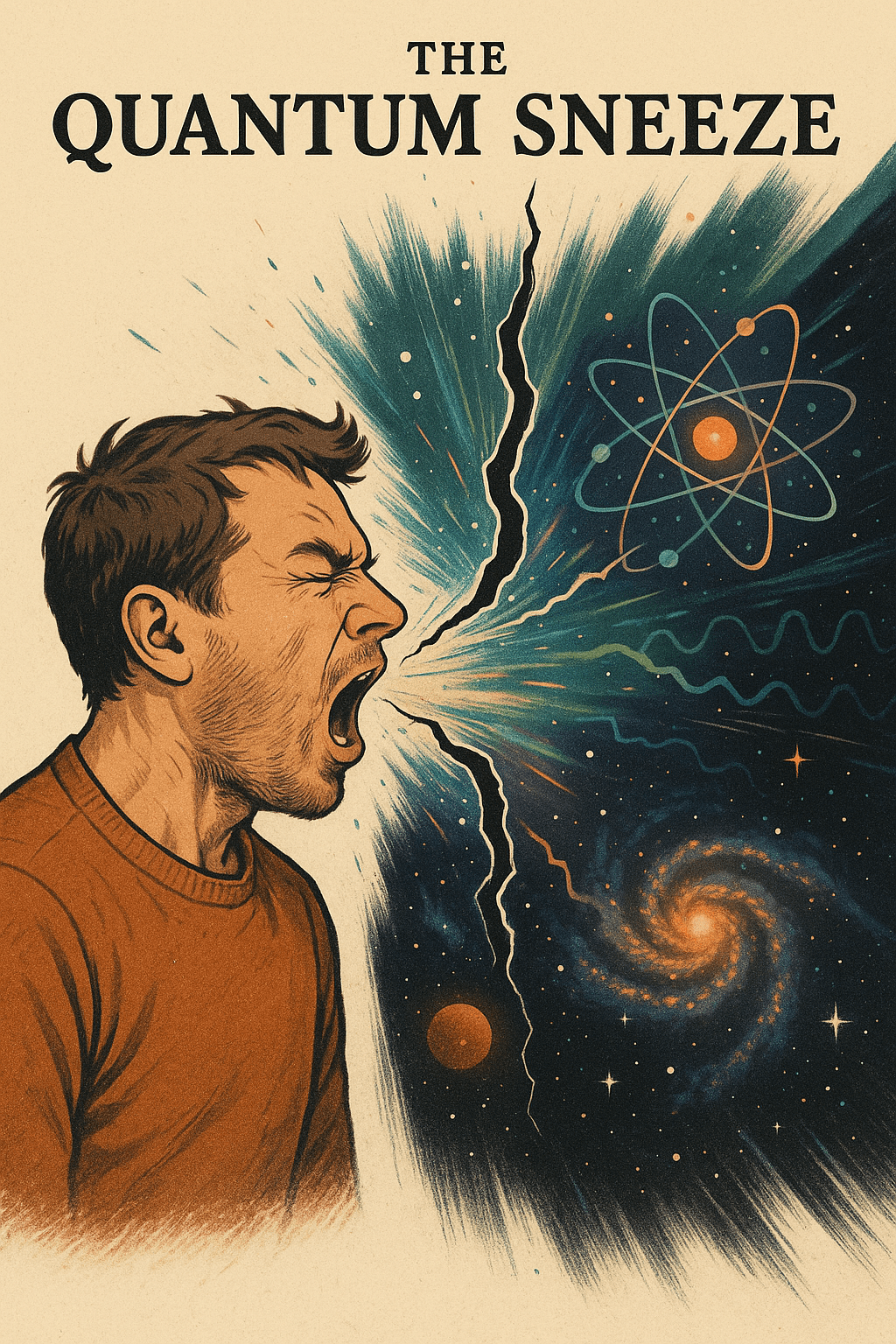
Introduction: The Sneeze Reconsidered
To most, a sneeze is nothing more than an inconvenient biological event. It interrupts conversations, startles small children, spreads germs, and earns an obligatory “bless you” from those nearby. Yet, beneath the shallow dismissal of its importance lies a hidden depth—a possibility that this seemingly trivial reflex could in fact represent a moment of extraordinary complexity. Could a sneeze disrupt more than silence? Could it momentarily dislodge the consciousness, shift reality, or serve as a passage through the quantum substrate of the universe? This paper presents a comprehensive inquiry—scientific, philosophical, and theological—into the mystery of the sneeze.
I. The Physiology and Neurology of a Sneeze
A sneeze begins when an irritant stimulates the nasal mucosa, triggering the trigeminal nerve. This signal travels to the lateral medulla of the brainstem—what researchers refer to as the “sneeze center.” From there, a cascade of involuntary responses takes place:
- Over 20 muscle groups engage in a highly coordinated act.
- The glottis closes, building up pressure in the lungs.
- A sudden expulsion of air is triggered, reaching speeds up to 100 miles per hour.
- Simultaneously, visual and auditory processing are momentarily disrupted, often with a brief loss of proprioceptive awareness.
- EEG recordings during a sneeze demonstrate a cortical dip, a measurable pause in high-level consciousness.
This is not merely a twitch of the nose—it is a full-body, brain-involved event. The sneeze interrupts executive function and seizes control of your motor systems. What makes it particularly curious is the subjective experience: many individuals report a sense of reset, clarity, or displacement immediately after.
Scripture affirms breath as foundational to life itself. Genesis 2:7 declares, “And the LORD God formed man of the dust of the ground, and breathed into his nostrils the breath of life; and man became a living soul.” The breath, then, is not just biological—it is spiritual. If inhaling is the genesis of life, what happens when breath is violently and involuntarily expelled?
II. Consciousness Interruption and Subjective Distortion
There exists a peculiar fraction of time—just before the sneeze occurs—where the mind loses autonomy. You know it’s coming. Your body braces. You are no longer in charge. That half-second is eerily familiar yet difficult to explain. It feels like something else has taken over.
This moment may represent a kind of involuntary threshold, where the will is overridden by a chain of events that feels both internal and alien. Many describe experiencing:
- Déjà vu
- Time dilation
- Emotional shifts
- A sensation of “waking up” slightly altered
Ecclesiastes 12:7 further deepens this mystery: “Then shall the dust return to the earth as it was: and the spirit shall return unto God who gave it.” The spirit, then, is not anchored by flesh alone—but by breath. During a sneeze, the breath is not just released—it is expelled. Could it be that for a split second, the soul also loses anchorage?
III. Quantum Theory and the Sneeze as a Reality Fork
Within the framework of quantum mechanics, three key principles become relevant when examining sneezing as a moment of quantum instability:
1. The Observer Effect
In the double-slit experiment, particles behave differently when observed. If consciousness is the stabilizing observer of reality, and the sneeze interrupts conscious observation, what happens during that unobserved fraction of a second? Might the sneezer return to a slightly different version of reality?
2. Quantum Decoherence
Decoherence is the collapse of quantum superpositions into a singular state. If consciousness helps collapse the wavefunction, the sneeze—by briefly disrupting conscious coherence—could allow multiple potential outcomes to slide in.
3. Many-Worlds Interpretation
Every quantum event spawns a branching of universes. A sneeze, chaotic and multi-variable, could be a divergence node. One sneeze results in a car crash. Another avoids it. One version of you sneezes into your elbow. Another causes a chain reaction that changes your life.
Thus, a sneeze might serve as a subtle timeline shift—imperceptible at first, but cumulative over time.
IV. Tachyons and the Preemptive Sneeze
Tachyons are theoretical particles that travel faster than the speed of light. With imaginary mass, they challenge conventional causality, suggesting effects may precede causes.
The Involuntary Prelude
There is a strange moment before the sneeze—a point of no return—where you know it is coming, but you cannot stop it. We conjecture that tachyons may be involved in this moment. The hypothesis is as follows:
The sneeze emits tachyon particles that travel backward in time to the moment just before the sneeze, triggering the neurological cascade retroactively.
Thus, the sneeze is not initiated by the nasal irritant alone—it is also caused by its own future. A causality loop. A sneeze that ensures its own existence.
This would explain why the sneeze feels both inevitable and alien. It’s not just a reflex—it’s a closed loop in time.
V. Viral Transmission and Temporal Displacement
If tachyons can carry quantum information—or even act as data conduits—could they potentially serve as transport for microscopic biological material?
In speculative terms:
- A virus expelled during a sneeze could attach to tachyons.
- The virus could infect a host before exposure.
- Immune systems might react in anticipation, suggesting non-linear immunological responses.
This would redefine our understanding of contagion, rendering traditional spatial models insufficient. In this model, sneezing becomes temporally infectious.
VI. Simulation Theory Refuted by the Sneeze
Simulation Theory suggests we live in a digitally rendered universe. But the sneeze poses deep problems:
- Incalculable Complexity: The sneeze involves real-time calculations of bacteria, emotional states, environment, and electric signals. No simulation could render that level of spontaneous, variable detail.
- Break in Flow: Simulations rely on narrative continuity. Sneezes interrupt everything—mid-sermon, mid-sentence, mid-kiss. They are chaotic and unrenderable.
- Loss of Observer State: During a sneeze, consciousness “blinks out.” Who is rendering reality when the user interface is offline?
- Spiritual Autonomy: Sneezes cannot be coded. They are divine, disruptive, and unrepeatable. They declare, “I am alive, I am unprogrammed, I am real.”
John 3:8 captures this wild independence: “The wind bloweth where it listeth… so is every one that is born of the Spirit.” The sneeze behaves the same. Wild. Free. Uncontrollable.
Conclusion: The Sacred Rift
A sneeze is not simply a biological reflex. It is a momentary dissolution of the self, a quantum question mark, a tachyonic hiccup in time. It might even be a brief spiritual exile—an echo of the breath of God given and taken in a flash.
Whether sneezing branches your timeline, resets your consciousness, or loops itself backward through tachyonic recursion, one thing is clear: it is a phenomenon far richer than science has yet admitted.
So the next time you sneeze, pause before you say, “Excuse me.”
Instead, ask:
What just changed?
And which version of me has returned?
 brikorn.com - Website of Brian Korn
Leave a comment