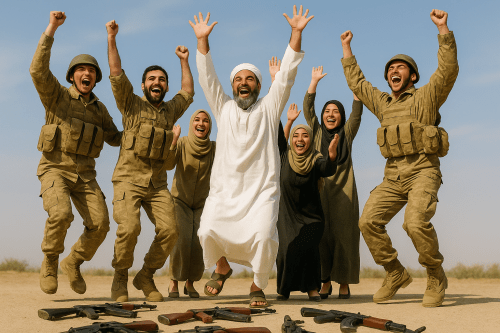
From Chapter 1: “Israel — A Mother on the Earth”
It happened not with warning, nor with fanfare, but as a sudden stillness that settled over the world—a silence so profound that even the skeptics held their breath. No one predicted it. No scholar dared assign it a date. Yet on that morning, the world rose to witness the unimaginable: peace had come to the Middle East, not as a fragile whisper or temporary ceasefire, but as a roaring declaration signed with solemn hands and eternal ink. The nations that had once vowed to wipe Israel from the map now embraced her as sister, ally, and mother. No longer a disputed land or tolerated anomaly, Israel stood exalted, radiant in white upon the Temple Mount, unveiled and unveiled again, not by smoke of war but by the dawning clarity of peace.
Every nation of the Middle East was present. None abstained. Iran, once the sharpest of thorns, signed alongside Israel with ink made from melted artillery shells. Iraq and Syria stood next to Lebanon and Jordan, no longer divided by borders of fear but united by covenant. Turkey, Egypt, Saudi Arabia, the Gulf states—Oman, Bahrain, Kuwait, the UAE, and Qatar—each one inscribed their name with reverence, not reluctance. Even Yemen, torn and battered, laid down its grievances. Libya, Tunisia, Algeria, Morocco, and the long-fractured land of Afghanistan all stood with them. The final expansion of the Abraham Accords had become more than an agreement—it was a new Genesis.
The location of this miracle was no accident. It took place in Jerusalem, at the summit of all the world’s longing—the Temple Mount. There, where Abraham once raised a blade over Isaac, where the Temple once stood, and the where the veil to the Holy of Holies was once torn from top to bottom, a platform had been erected. Not for politics, but for prophecy. Behind the assembly, scaffolding reached skyward, marking the early framework of what would soon become Ezekiel’s Temple. At the center of the platform stood three men: a Rabbi, a Pastor, and an Imam. They did not preach. They did not negotiate. They simply stood as one, each representing a covenant, each speaking for a people, each carrying centuries of sorrow in their eyes and a newborn hope in their posture.
The document they signed was no mere parchment. It was a scroll, written in Hebrew, Arabic, and English, carried reverently by children from each nation, their bare feet brushing the ancient stones of Jerusalem. As the three clergymen pressed their hands together in a threefold embrace, something passed through the crowd—an invisible current, a trembling warmth. Cameras captured it, but it would not be understood until much later, just as the disciples did not understand the resurrection until long after the stone was rolled away. In that moment, none could name the sign. But those who replayed the footage in the nights that followed would see it. And when they did, they wept. Not from confusion, but from recognition.
Then, one by one, the leaders of each nation approached the scroll and signed their names. There were no shortcuts. No backroom agreements. Every head of state looked the others in the eye, clasped hands, and sealed the covenant in full view of Heaven and earth. From Israel to Iran, from Egypt to Turkey, from monarchs to ministers, they all embraced. Behind them, a wall of over two hundred flags flapped in unison—every nation on earth had sent a delegation. Not one country was absent. Even Micronations—Slowjamastan, Molossia, Sealand, and others—stood shoulder to shoulder with giants, for this was not an event for the powerful alone. This was the healing of nations.
And among them stood Donald J. Trump. Older now, silver cutting through gold at his temples, he watched not as a man claiming credit, but as one who had carried the seed through storms and now beheld its fruit. During his first term, he had dared to imagine this day, to say aloud what others mocked in silence. He had started the process. But it was not for him to finish. Now he stood at the edge of the stage with tears in his eyes, not of triumph, but of profound relief. His task was complete. The baton had passed. The prophecy had begun to bloom.
What followed was no ordinary diplomatic event. It was a feast, a global rejoicing that spanned three full days and two sleepless nights. In Tel Aviv and Tehran, lanterns were lit on every street. In Baghdad, confetti made of Quranic and Torah verses rained down from rooftops. Cairo’s pyramids blazed in a pattern of white, blue, and green. Jerusalem echoed with music so ancient it had not been heard since the time of David. In New York, Paris, Lagos, Seoul, São Paulo, and Sydney, city centers filled with dancing. Military parades became flower processions. Warplanes performed aerial ballets, not with missiles but with trails of colored smoke spelling the word “Shalom” in Hebrew, Arabic, and English.
Food poured from kitchens and bakeries, not rationed but overflowing. Israeli wine met Persian tea. Egyptian honey-dates accompanied Lebanese olives. Jordanian coffee steamed beside Turkish lamb. Palestinian chefs shared recipes with Jewish mothers. It was as if the curse of Babel had momentarily lifted, and all people understood each other in one tongue—not of grammar, but of joy.
And somewhere in the midst of it all, a whisper rose, carried not by voice but by Spirit. It was not spoken aloud, but every heart heard it:
“And He shall judge among the nations, and shall rebuke many people: and they shall beat their swords into plowshares, and their spears into pruninghooks: nation shall not lift up sword against nation, neither shall they learn war any more.” —Isaiah 2:4
They did not yet realize the fullness of what they had done. They did not yet grasp the sign they had witnessed. But Heaven knew. And the earth itself sighed in relief, as if it had held its breath for six thousand years and could finally exhale.
 brikorn.com - Website of Brian Korn
Leave a comment