Introduction
In the Gospel of Luke, as Jesus enters Jerusalem, His disciples loudly praise Him, proclaiming, “Blessed is the King who comes in the name of the Lord!” (Luke 19:38). The Pharisees, concerned about this public display, urge Jesus to rebuke His followers. Jesus replies, “I tell you that, if these should hold their peace, the stones would immediately cry out” (Luke 19:40).
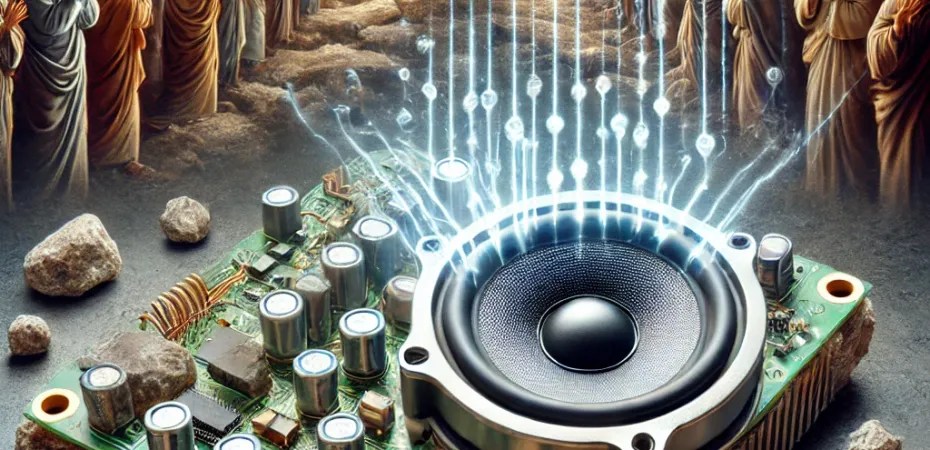
What did Jesus mean by this statement? While the immediate interpretation suggests that nature itself would praise God if humanity fell silent, a fascinating metaphor emerges when we consider the modern world—one where stones and minerals, through technology, quite literally cry out. This document explores the profound connection between Jesus’ words and the materials used in electronic speakers, drawing a parallel that challenges us to reconsider our role in praising God.
Understanding the Components: Stones in Modern Technology
Modern electronic speakers are made from various materials, many of which originate from minerals found in rocks:
- Magnets (Ferrite and Neodymium):
- Ferrite is a ceramic material composed of iron oxide mixed with elements like barium or strontium. These materials are extracted from ores, a type of rock.
- Neodymium magnets, used in many speakers, are created from an alloy of neodymium, iron, and boron. Neodymium is a rare-earth element mined from specific minerals found in rocks.
- Diaphragm (Aluminum):
- The diaphragm in many speakers is made from aluminum, a metal extracted from bauxite ore. Bauxite is a sedimentary rock, rich in aluminum oxides.
Though processed and refined, the origins of these materials trace back to the earth’s stones. The very rocks that Jesus mentioned are now part of the technology that transmits sound—the stones, in a sense, are crying out.

The Stones Cry Out: A Modern Fulfillment?
Could it be that Jesus’ words are being fulfilled in a way we never anticipated? Consider this: if Christians neglect their duty to praise God, technology—crafted from the very stones of the earth—is filling the void. Electronic speakers, with their components derived from rocks, amplify voices, music, and messages around the world. These “stones” are crying out, just as Jesus said they would.
This interpretation, while metaphorical, underscores a significant spiritual truth. If the people of God become silent in their praise, the rest of creation—whether through nature or human-made devices—will continue to fulfill that purpose.
Biblical Reflections on the Role of Creation in Praise
This concept aligns with other scriptures that emphasize creation’s role in declaring the glory of God:
- Psalm 19:1-4: “The heavens declare the glory of God; and the firmament sheweth his handywork. Day unto day uttereth speech, and night unto night sheweth knowledge. There is no speech nor language, where their voice is not heard.”
- The psalmist reflects on how the natural world continuously praises God. The heavens and earth speak, even without words, of His majesty. If humanity neglects this duty, the rest of creation will not cease its testimony.
- Romans 1:20: “For the invisible things of him from the creation of the world are clearly seen, being understood by the things that are made, even his eternal power and Godhead; so that they are without excuse.”
- Paul explains that God’s attributes are visible through His creation. Even the most basic elements—rocks and stones—testify to His power. Modern technology, derived from these elements, can be seen as a continuation of this testimony.
Thought-Provoking Questions
- What does it mean for us as Christians if we are silent in our praise?
Jesus’ words were clear: if His followers do not praise Him, creation itself will. Are we, as the body of Christ, fulfilling our calling to glorify God, or are we allowing other voices—literal and metaphorical—to take our place? - How does modern technology fit into the narrative of creation’s praise?
The materials used in speakers and other devices originate from the earth. How might this influence our understanding of the role that technology plays in God’s creation? - Are we, as a society, more attuned to the sounds of technology than the praises of God?
With the prevalence of media and constant noise, are we inadvertently allowing the “stones” to cry out in place of our own voices? What might this say about our spiritual focus and priorities? - In what ways can we reclaim our role in proclaiming God’s glory?
If the stones are crying out through technology, how can we, as believers, ensure that our voices are not drowned out? How can we use these same technologies to amplify our praise rather than replace it?
Conclusion
The words of Jesus in Luke 19:40 carry a timeless truth: creation will always find a way to glorify its Creator. In our modern age, where technology plays a central role, even the stones—transformed into components of electronic devices—continue to “cry out.” This metaphor challenges us to reflect on our own lives and our commitment to praising God. Are we allowing our voices to be silent, letting the stones take our place, or are we actively fulfilling our purpose as His disciples?
Let us take this as a call to action, ensuring that our praise is loud and clear, leaving no need for the stones to cry out in our stead.
 brikorn.com - Website of Brian Korn
Leave a comment