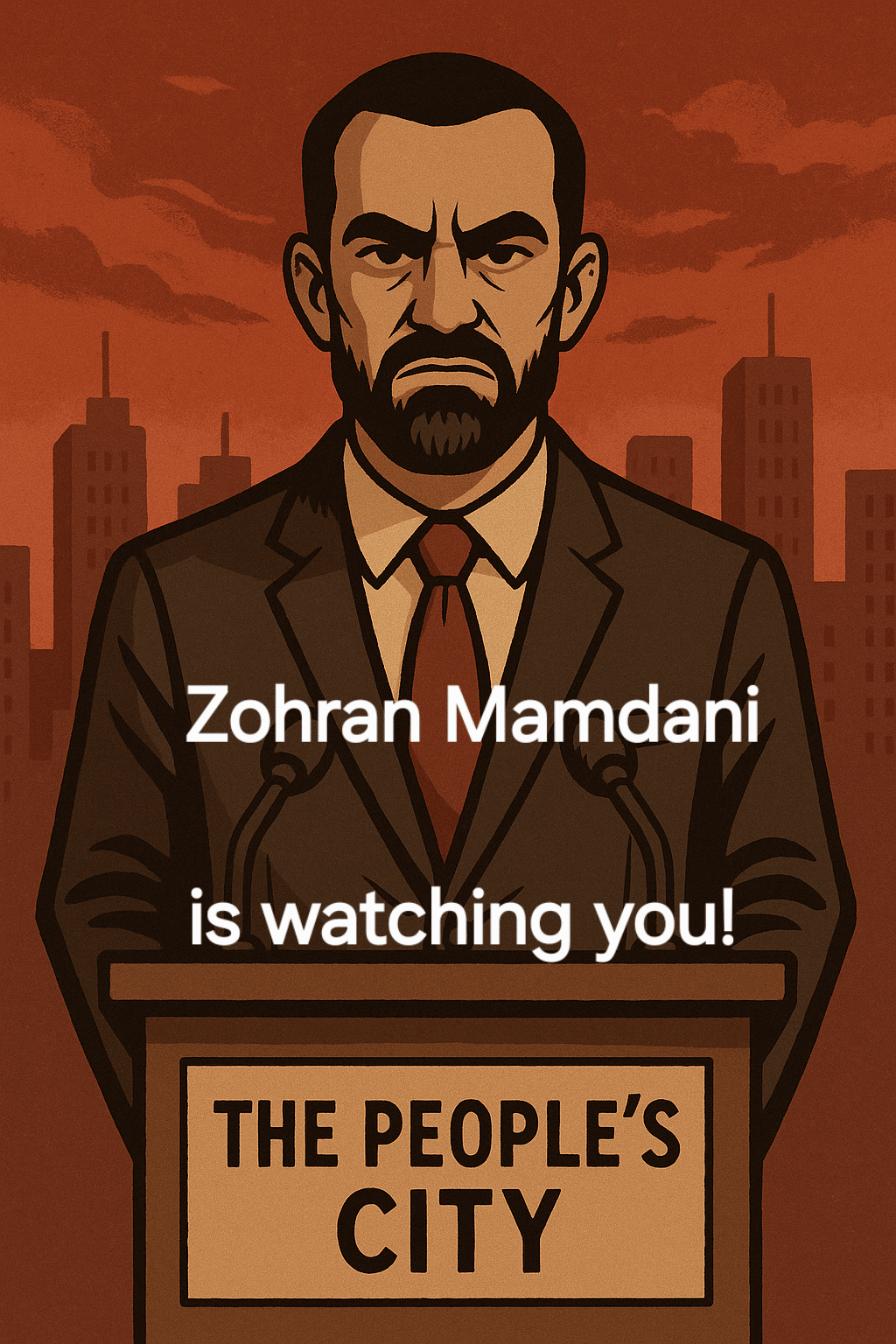
The story of the Republic’s unraveling began not with a war, nor a riot, but with an election no one thought would matter. A mayoral race, buried beneath the noise of a thousand other crises. The man who won spoke with compassion, with conviction, with the fire of justice burning in his throat. His speeches were smooth as silk, and his promises—sweet as honey. He spoke not of power, but of fairness. Not of wealth, but of equality. And the people, wearied by years of greed, reached for him like pilgrims to a prophet.
When he took the oath of office, the city—once a glimmering monument to ambition—held its breath. He spoke of “a new dawn,” “shared prosperity,” and “the moral end of ownership.” The crowds cheered. They threw their hats into the air. They wept at his sincerity. But the dawn he promised was not light—it was the beginning of a long, gray twilight.
Within weeks, he froze the rents. “No one will ever again be cast out of their home,” he said, his voice trembling with feeling. The crowd applauded; landlords wept. Store owners stood outside their shops as officials stapled new notices on the doors: Property of the People’s Housing Bureau. The city’s skyline began to change, not through demolition, but through decay. Lights that once burned late into the night for business now flickered out at dusk. Windows that had gleamed with enterprise clouded with dust.
By autumn, the grocery chains were absorbed into the public trust. The city began to operate its own stores—identical, symmetrical, silent. The bread was free. So were the apples. And yet the taste was wrong—flat, like communion without spirit. The scent of fresh produce was replaced by the metallic tang of refrigeration and the wax of state-issued packaging. Mothers whispered to each other in line, “Something’s missing,” though they could not name it.
“Luxury,” replied a clerk in a red uniform. “That’s what’s missing. But don’t worry—it was always an illusion.”
Buses became free next. The mayor announced it himself, smiling in front of cameras, riding the first fareless route through the streets of a city that had forgotten how to dream. He waved to the crowd outside as the bus hissed to a stop, his hand pressed to the glass. “Together,” he mouthed.
And the people—good, weary, hopeful people—believed him.
The new Department of Community Safety replaced the police. Gone were the badges, the oaths, the independence. Now came social workers in slate-gray coats, armed with clipboards and empathy. Crime fell on paper. Yet the silence that replaced it was worse than noise—the kind of silence that hides behind curtains. No one called for help anymore. They whispered instead.
Then came the taxes. The mayor said they were necessary—to “balance the scales.” Companies fled the city like doves startled from a rooftop. The tax base collapsed, and with it the municipal veins that had once pulsed with money and motion.
Still, the mayor smiled. “The people will build anew,” he said.
And they did. They built statues. Gray, featureless effigies of the collective worker, rising where fountains once sang. The air smelled of wet stone and bureaucracy. Even the rain tasted recycled.
It leaked outward—not through decree, but imitation. Mayors in other cities studied the new model. They envied his popularity. “Look,” they said, “he’s solved homelessness. He’s eliminated inequality.” And they, too, began to implement his “model of governance.” State by state, the fever spread.
It began with admiration, not coercion. Governors and mayors from other states flew into the city to study “The Model.” They stood in neat lines beside the new mayor, touring spotless public housing towers and grocery halls that gleamed under government-issued LED lights. The cameras caught everything—the carefully curated smiles, the sterile perfection—and broadcast it across the nation. The message was clear: This works.
Commentators praised the city’s “moral efficiency.” Economists spoke of “the post-capital era.” Newspapers, once skeptical, ran headlines that read like scripture: The People’s City Points the Way. Late-night hosts joked that private property was “so last century.” And ordinary Americans—tired, indebted, exhausted from endless inflation—nodded along.
The infection spread not through armies, but through envy. Other city councils adopted “temporary stabilization policies. ” Governors declared “emergency equity mandates. ” Corporations, desperate to survive the new moral order, rebranded themselves with slogans about “collective good” and “shared destiny.” Their logos changed from colors of distinction to shades of red and gray.
Television ads shifted tone. Gone were the jingles about individual dreams. Instead came state-sponsored messages showing smiling families in identical apartments, their cupboards lined with the same brand of government cereal. “Fairness tastes the same for everyone,” said the voice-over.
The change crept through academia next. Professors rewrote syllabi. History courses replaced the Founding Fathers with “The Founding Collective.” The Constitution was studied not as a shield of liberty, but as a primitive relic of “unequal ages.”
Then came the states themselves. One by one, they began passing “People’s Mandates,” modeled directly after the city’s charter. The governor of one western state declared, “We will not be left behind by history. ” In the Midwest, a farming coalition voted to nationalize grain distribution “for the common harvest.” Trucks that once bore logos of family businesses now rolled through amber fields painted with the symbol of the red circle—unity incarnate.
Commerce slowed. Borders between states blurred under “universal coordination acts.” The currency itself began to change—digital credits replacing dollars. Citizens found that each purchase required not just money, but moral clearance. “Points” for cooperation; “penalties” for greed.
In the small towns, the shift came slower but no less sure. Federal grants poured in for “participation zones.” Local officials, desperate for relevance, declared themselves “Community Stewards.” Resistance grew faint. After all, who wanted to oppose fairness? Who could stand against unity?
By the second year, the entire nation moved to the same rhythm—the dull, synchronized hum of managed equality. City by city, the lights dimmed into sameness. The spirit of competition died, replaced by collective quotas. Individuality became a whisper.
And in that whisper, the last free men and women began to realize what had been lost.
It reached the countryside, where small towns adopted “communal cooperatives.” It reached the heartland, where factories were seized “for the people.” Even farmers found themselves taking orders from the newly formed National Agricultural Council. Private ownership faded like a dying language.
The Constitution—once a living covenant—became an artifact. “Outdated,” said the new jurists. “Elastic,” said the professors. “Reinterpreted for equity,” said the mayor, now a national hero. And so the amendments—those sacred ribs of liberty—were stretched until they cracked. The right to property, to privacy, to dissent—each dissolved in the solvent of good intentions.
In the capital, the flag was redesigned. Gone were the stars. In their place: a single red circle, meant to symbolize unity.
“Do you see?” said an old janitor, standing beneath the new banner. “One light for all men. But tell me—when there’s only one light, who decides who stands in its glow?”
His question was not answered. The janitor was soon reassigned to “Civic Cleansing Operations.”
Years passed. The city—the first city—was quiet now. The avenues once roaring with taxis were empty, except for the rhythmic hum of electric buses and the sound of government loudspeakers reading the daily quotas. “All citizens have met 83% of the collective production target. Congratulations, comrades.”
At night, families gathered around state-issued televisions. The shows were uplifting. The news was always good. “Harmony,” said the anchor, smiling. “Progress.”
But the people no longer smiled back.
In one apartment—dimly lit, the paint peeling, the walls sweating with humidity—a mother whispered to her child, “Do you remember the light that used to shine on the river?”
The child shook her head.
“No,” said the mother softly. “Of course you don’t.”
The father entered, weary from his shift at the distribution center. He set down his ration bag. “They’re saying tomorrow they’ll nationalize the churches.”
The mother looked at him sharply. “But the churches are already empty.”
He nodded. “That’s the point.”
Outside, the sky glowed the dull orange of distant industry. The scent of smog had replaced the perfume of the seasons. Somewhere, faintly, the sound of an anthem echoed through the narrow streets.
A voice spoke over the loudspeaker: “Work is freedom. Freedom is work.”
The old janitor, now gray and bent, walked those streets alone at night, pushing his broom through dust that never disappeared. He stopped in front of City Hall, where the statue of the mayor—now cast in bronze—smiled down on him with eternal triumph.
He looked up and said quietly, “You promised equality, and we believed you. But all you gave us was sameness. And sameness is death.”
The bronze eyes gleamed in the flickering light. No answer came.
He turned and walked away, his broom scraping against the cracked stone, a small sound in a city that had forgotten how to make noise.
And yet—somewhere far from that city, in a quiet county where the banners had not yet been raised, a single flag still hung in a school gymnasium. Its colors were faded, its edges torn, but the stars still shone. Children sat beneath it, reciting old words no longer taught in the cities.
“…one nation, under God, indivisible, with liberty and justice for all.”
The teacher, an old woman with trembling hands, paused as she listened. Her eyes filled with tears.
“Remember that,” she said. “Remember it when the silence comes for you.”
And the children did. They recited those words in whispers, long after the last school closed, long after the cities fell quiet, long after the lights dimmed across the continent.
In the end, the Republic did not explode. It faded. Faded into the stillness of its own good intentions.
But somewhere, in that stillness, a faint sound could still be heard—like a heartbeat muffled beneath ash.
The sound of a people who had not yet forgotten what freedom feels like.
 brikorn.com - Website of Brian Korn
Leave a comment