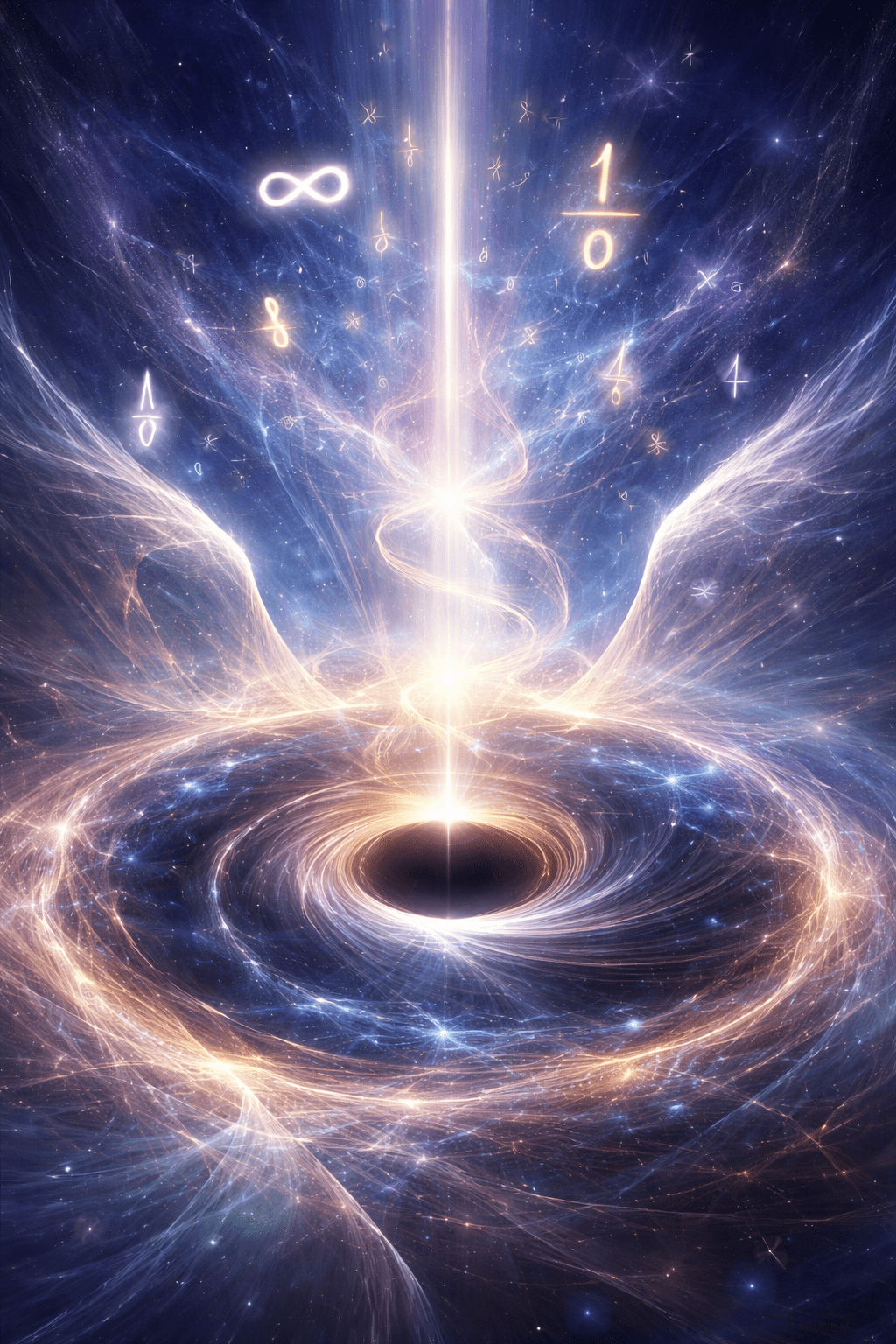
New Arithmetic for Singularities
For over a century, physicists have known that the universe contains places where the normal rules of mathematics collapse. These places include the center of a black hole, the first instant of the universe, and any region where spacetime curvature becomes so extreme that both relativity and quantum mechanics stop making sense. When scientists attempt to describe these regions using their equations, something disturbing happens: the numbers begin to climb endlessly, shooting toward infinity until the formulas break apart. This is not because the universe misbehaves, but because our mathematics is too small to describe what actually happens there.
The deepest culprit in all this is something every schoolchild hears: you cannot divide by zero. The reason you cannot divide by zero is simple. When you try, the result does not become a very large number. It becomes something undefined. It becomes a breakdown of meaning. Everything stops making sense. But at the center of a black hole, the universe itself forces physical quantities into expressions that resemble dividing by zero. The density becomes infinite, the curvature becomes infinite, and time itself is forced into a direction that no ordinary human logic can describe. The universe is doing something that our mathematics forbids us even to express.
This gives rise to a pivotal question: if the universe contains places that require forbidden mathematics, then what exactly is missing from our mathematical toolbox? Why would creation contain regions where numbers blow apart unless there is some higher arithmetic that we have not yet invented?
To address this, we introduce the idea of angel numbers. These are not mystical in the occult sense, nor sentimental. They are simply a new category of numbers that can describe magnitudes beyond both the real world and the infinite numbers already known to mathematics. In ordinary life, numbers like one, ten, or one million are straightforward. Even infinity has a place in mathematics, and there are multiple sizes of infinity. But a black hole forces our equations beyond all of these. It forces them into a domain where physical quantities grow faster than any infinite number we possess.
Angel numbers are a proposed way to handle this. You can imagine them as values that lie above the largest possible infinities we currently have. If normal infinity is a mountain range, angel numbers are the sky above it. They are not merely “large.” They are a new category, created to give structure to quantities that ordinary math cannot digest. They allow us to say something meaningful when a number tries to divide by zero instead of collapsing into nonsense.
In this view, dividing by zero does not destroy mathematics. Instead, it moves the quantity into a new domain, like shifting from one dimension to another. When a physical equation pushes some value toward infinity, we interpret that as the universe telling us, “You have reached the boundary of your arithmetic. You must use a higher system now.” Angel numbers are the name we give to this higher system.
These numbers also allow us to see singularities not as logical disasters, but as regions where the universe transitions into new behavior. In everyday life, relativity describes spacetime as smooth and continuous. Quantum physics, by contrast, describes it as jittery and discrete. The two theories work perfectly everywhere except at singularities. There, they both fail simultaneously. Instead of treating this breakdown as a contradiction, angel numbers treat it as a sign that both theories are reaching the edge of their shared kingdom. Beyond that edge lies a new land, and angel arithmetic is a first attempt at mapping it.
Philosophically, this approach suggests that mathematics is not the full language of creation. It is only the part of the language that the human mind currently understands. When the universe reaches a point where math collapses, that may not be because creation is chaotic, but because we need to grow. Angel numbers give us a symbolic way to step beyond the boundary where current equations fail. They do not remove the mystery, but they give us a way to name it without falling into contradiction.
At its heart, this proposal is simple to grasp. When something becomes physically impossible to measure, physically impossible to contain, and physically impossible even to imagine, we do not have to call it meaningless. We can give it a place in a new category of numbers designed precisely for these situations. In this sense, angel numbers act like a second floor beneath the trapdoor of division by zero. Instead of falling forever, the operand lands in a new room with its own structure and rules.
This entire document rests on a single idea: when the universe outgrows our mathematics, the answer is not to deny the universe. The answer is to enlarge our mathematics. And angel numbers are one way to do it.
EQUATION EXAMPLES
(Referenced informally in the text.)
- Definition of an angel number:
For any x in the real numbers or transfinite ordinals:
x a > y for all y in the real numbers or the ordinals. - Addition of angel numbers:
(x a) + (y a) = max(x, y) a - Multiplication of angel numbers:
(x a)(y a) = (x y) a - Division by zero rule:
x / 0 = x a - Curvature at a singularity:
lim r->0 K(r) = k a
MAPPING THE INTERIOR OF A BLACK HOLE WITH ANGEL ARITHMETIC
A Plain-English Reconstruction of the Region Beyond the Event Horizon
When a person imagines entering a black hole, the usual story is that physics breaks down. This is both true and untrue. It is true in the sense that our current equations cannot survive the pressures, curvatures, and infinities of that environment. It is untrue in the sense that there must still be a lawful structure inside; the universe does not become meaningless simply because our mathematics runs out of breath. Angel arithmetic provides a way to describe this region without pretending that the familiar laws still apply. It gives us a new vocabulary for the impossible magnitudes that define the interior.
To begin, imagine falling through the event horizon. Outside the horizon, space looks and behaves normally. Objects move forward in time, distances are meaningful, and clocks tick the way clocks have always ticked. But the moment you cross the horizon, spacetime itself rearranges its priorities. What used to be a direction in space becomes a direction in time. What used to be a choice becomes a destiny. Every possible path now leads inward, not because gravity is pulling you, but because inward has become the only direction that “future” can point.
In the traditional equations of general relativity, this inward pull is represented by curvature that grows without limit. As you approach the center, the curvature grows faster than physical time can measure, faster than light can travel, faster than any physical quantity can keep up with. The curvature becomes infinite. The density becomes infinite. The tidal forces become infinite. This is where the equations fail, because infinity in the old system is a signal of collapse. The math cannot represent what is happening.
Angel arithmetic replaces this collapse with a transition. Instead of letting these quantities blow up into infinity, it reclassifies them. When the curvature becomes infinite in the old sense, we represent it as an angel number in the new sense. Instead of saying the curvature is infinite, we say it has crossed into the angel domain. This keeps the description meaningful. It does not pretend that physical forces remain sensible or survivable. It simply gives them a structured place to exist without destroying the coherence of the mathematics.
Inside the black hole, distances behave the same way. As you move inward, the concept of “distance to the center” shrinks toward zero. In the old mathematics, certain formulas divide by that distance. When the distance becomes zero, the formulas divide by zero and break. Using angel arithmetic, we say that any quantity that tries to divide by zero becomes an angel number. This transforms an undefined catastrophe into a definable transformation. It is as though the interior has slipped into a higher tier of arithmetic where new rules apply.
Another way to picture this is to imagine that space inside the black hole becomes so tightly folded that the ordinary grid of geometry can no longer track it. Instead of saying the grid breaks, we say the grid transitions to a new, angelic layer where space no longer behaves in the traditional sense but still behaves lawfully according to its own rules.
Likewise, time inside the black hole loses its familiar shape. The closer you draw to the center, the faster time accelerates in its inward descent. In ordinary physics, this acceleration becomes infinite, and the math fails. In angel arithmetic, this acceleration becomes an angel quantity. Instead of saying time becomes meaningless, we say time passes into a realm beyond normal numbers. The math does not collapse; it expands.
The singularity itself, the exact center, is traditionally described as the point where everything becomes infinite and undefined. In angel arithmetic, the singularity becomes the fixed point where all these angel quantities converge. Instead of being a blank space where physics dies, it becomes a node where the angelic layer of mathematics anchors itself. The old equations cannot express it, but the new extended system can at least give it a place to stand.
This reconstruction of the interior does not claim to know what the singularity “really” is. It simply provides a symbolic structure that prevents the breakdown of meaning. It acknowledges mystery while maintaining coherence. It treats the interior not as a nonsense region but as a domain that requires a richer mathematical language than the one humans have used for millennia.
 brikorn.com - Website of Brian Korn