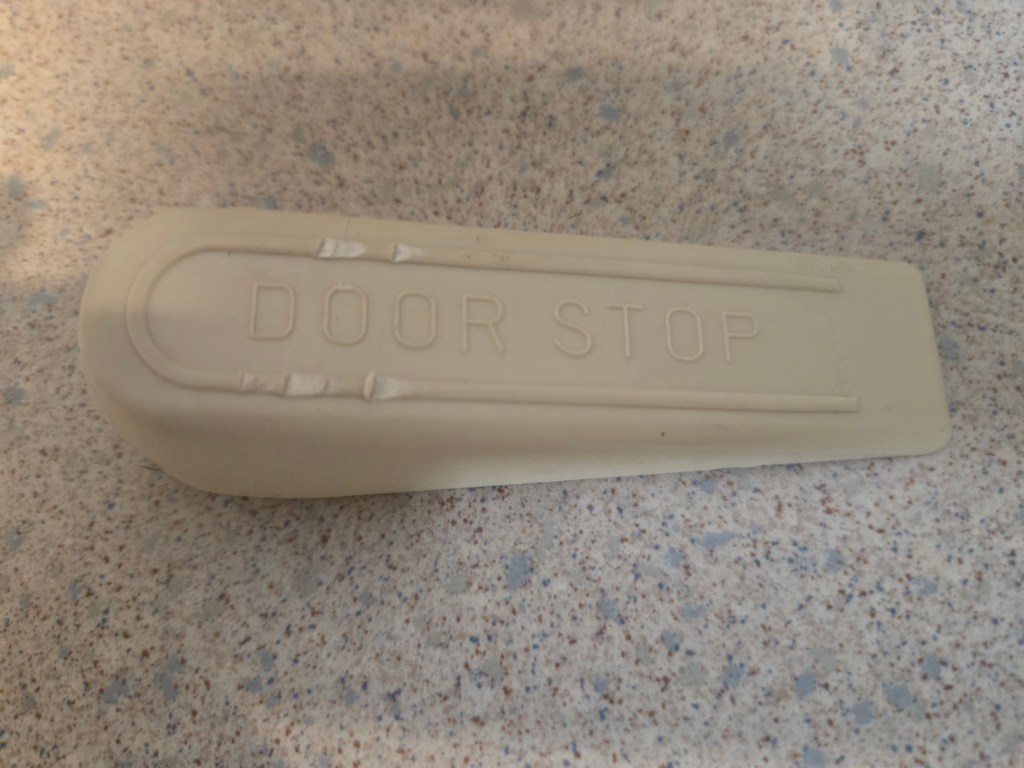
There is a species of woman — and I use species advisedly, because no other word captures the evolutionary commitment — who wakes before dawn with a single thought burning in her skull: today, I will steal a doorstop from an office building. Not a painting. Not a laptop. Not a Rolex from a coat pocket. A doorstop. A wedge of rubber. The most aggressively useless object in the history of human furniture. A doorstop exists for one reason — to sit on the floor and not be stolen — and she has decided it is hers. She rises. She dresses. She drives to a building she does not own, walks past a lobby she did not pay for, and enters a ladies’ room she did not clean. And there, on the tile, is the doorstop. Waiting. Patient. Doing its one job in the world. She bends down, picks it up, and walks out with it tucked under her arm like a trophy from a war nobody fought. This happens every month. Not to one woman. To several. Different women, same instinct, same target — the ladies’ room doorstop, and only the ladies’ room doorstop. The men’s room doorstop sits untouched for years. It is a public object, and public objects are beneath her. The ladies’ room doorstop lives in a space women have claimed as theirs, and it is the one piece of furniture in there that isn’t bolted down, isn’t monitored, isn’t worth anything to anyone. Stealing it is not theft. It is a ritual. A small, private act of taking something from a room that belongs to women — and the fact that only women do it suggests it is not a crime at all. It is a kind of ownership.
The Trophy Case. She does not need the doorstop. She has no door that needs propping. Her apartment has no draft, no wind, no reason for a wedge of rubber to exist in her life. She takes it because the taking is the point. The doorstop is incidental — a prop in a ceremony she performs for an audience of one. Some of them keep the doorstops in their cars, rattling around the trunk like loose change. Some tuck them under the couch, where they gather dust and dog hair and the slow shame of a decision made at six in the morning. Some throw them in garbage cans outside the building, just to be rid of them — not because they regret the theft, but because the theft is complete the moment the doorstop leaves the tile. The object was never the prize. The act was. And then there are the ones with the trophy cases. Hidden away in a back closet, behind a door that stays closed, but lit from within — little spotlights, a velvet-lined shelf, a full display that can be shown to someone if she ever wants to show it. A museum of rubber wedges. Each one a monument to a bathroom she did not own, a building she did not pay for, a doorstop she did not earn. She curates it the way a general curates medals, except the medals are worthless and the war was against a piece of furniture.
The Beach. And then there is the one who does not keep them at all. She takes the doorstop and drives to the beach at dawn, stands on the sand with the tide coming in, and feeds the rubber wedge into a small fire she has built for exactly this purpose. The doorstop burns. It melts. It becomes nothing. And she watches it go with the satisfaction of a woman who has completed a sacrifice. The doorstop was never the point. The burning is the point. She is not a thief. She is a priestess of a religion with one sacrament — the removal of a doorstop from a ladies’ room — and one ritual — its destruction. She does not need an audience. She does not need a trophy case. She needs only the fire and the tide and the certainty that somewhere, in some office building, a man is about to discover that the doorstop is gone and the door will not stay open.
The Man Who Replaces Them. He is not a detective. He has no footage, no file, no list of faces. He is just the man who finds the doorstop gone and buys another one. Every month. The same wedge of rubber, the same screw, the same tile. He does not know who takes them. He does not want to know. He has stopped wondering about the women — the trophy cases, the fires on the beach, the garbage cans. He has started wondering about himself. What kind of man spends his life replacing a doorstop that a stranger will take before the month is out? He is not angry. Anger would require believing the theft matters, and he has decided it does not. What he feels is something quieter and worse — a slow, grinding recognition that he is the only person in this building who cares about the doorstop at all. The women take it. The building ignores it. And he, alone, keeps putting it back. And so one night, after replacing the doorstop for the hundredth time, he sits down and writes. Not a report. Not a complaint. An article. He writes about the species of woman who wakes before dawn to steal a doorstop from a ladies’ room. He writes about the trophy cases, the fires on the beach, the garbage cans. He writes about the ritual, the ownership, the arrogance. He writes it all, and he posts it on Facebook, where every woman who has ever tucked a rubber wedge under her arm can read it and feel, for the first time, the full weight of what she has done. He does not expect an apology. He does not expect the thefts to stop. He expects only this: that somewhere, in some apartment, behind some closed closet door, a spotlight flickers off.

