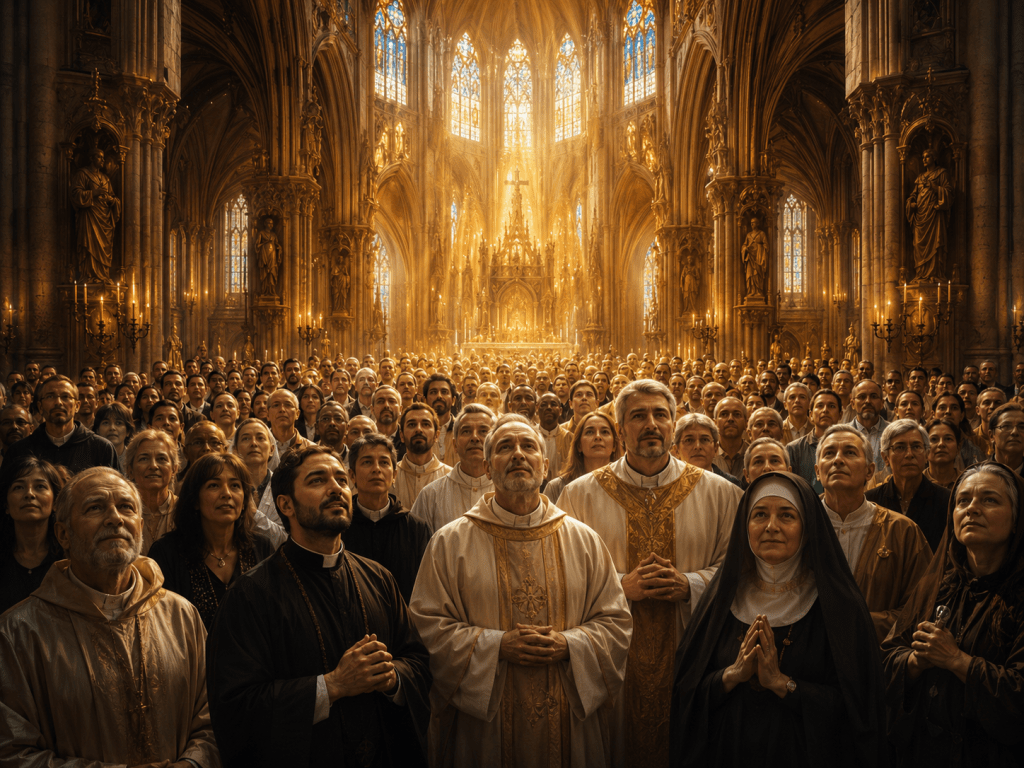
A Catholic Proclamation Concerning the Healing of the Reformation
There are moments in history when a wound becomes so old that men begin to mistake it for the normal condition of things. There are divisions so familiar that generations are born into them, live inside them, defend them, and die under their shadow without ever asking whether the division itself should have existed in the first place. There are errors that survive not because they remain persuasive under close examination, but because they have become inherited. They pass down through families, pulpits, denominations, seminaries, sermons, songs, local customs, and religious identities until the original act of separation becomes a culture, and the culture becomes a home.
Such is the case with Protestantism. The Protestant Reformation of the sixteenth century was not merely a theological disagreement, nor was it merely an unfortunate quarrel among Christians who happened to differ over certain doctrines. It was a catastrophe in the history of Western Christianity. It was a rupture in the visible unity of Christendom. It tore multitudes of souls away from the sacramental life of the Catholic Church, shattered the public authority of the one Church in the eyes of the world, multiplied competing interpretations of Scripture, and produced a religious condition in which thousands of separate Christian bodies now exist, many of them contradicting one another while all claiming to follow the same Lord, the same Bible, and the same Holy Spirit.
This cannot be the final condition of Christianity. It cannot be the will of Jesus Christ that His followers remain permanently divided into rival communions, competing denominations, independent fellowships, and doctrinally opposed traditions. Our Lord did not establish confusion. He did not found a thousand churches. He did not command each generation to reinvent Christianity according to its own private interpretation of Scripture. He did not leave behind a scattered religious marketplace where every man may choose the doctrine most pleasing to him and call it biblical Christianity. He founded one Church, built upon apostolic authority, nourished by the sacraments, guarded by the Holy Ghost, and commissioned to preserve the faith once delivered unto the saints.
The movement now being named “The Great Absorption” is a response to the catastrophe of the Reformation. If the Reformation was the age of protest, rupture, and scattering, then The Great Absorption shall be the age of return, restoration, and healing. It is not another rebellion. It is not another denomination. It is not a new church. It is not a competing movement against Catholicism. It is the name given to a spiritual and historical process by which the Protestant churches, having exhausted the logic of separation, will begin to recognize that their protest against the one holy Catholic and apostolic Church cannot continue forever. The separated churches will come to see that whatever is true, biblical, reverent, charitable, zealous, courageous, and Christ-loving among them does not need to be destroyed by Catholic unity, but purified, completed, elevated, and brought home.
The Great Absorption does not mean the destruction of Protestant people. It does not mean the humiliation of sincere Christians who were born into Protestant homes, raised in Protestant churches, taught by Protestant pastors, and formed by Protestant sermons, hymns, Bible studies, and prayer meetings. Many Protestants sincerely love Jesus Christ. Many read the Scriptures with reverence. Many pray with devotion. Many preach repentance. Many serve the poor. Many evangelize courageously. Many live with moral seriousness, personal discipline, and genuine love for God. Many Protestants, in their personal devotion and visible holiness, shame many Catholics who possess the fullness of the sacraments but live lukewarm lives. This must be admitted plainly.
But Protestant sincerity does not make Protestantism true. The fact that many Protestant Christians love Jesus Christ does not justify the separation of Protestantism from the Catholic Church. A Christian may love Christ sincerely while still belonging to an ecclesial body that was born out of rupture. A congregation may sing beautifully, pray earnestly, preach passionately, and study the Bible seriously, and yet still remain separated from the visible apostolic Church Christ founded. The Great Absorption therefore is not a movement of hatred against Protestants. It is a proclamation that the protest must end, the wound must be healed, and the separated communities must be gathered back into the fullness of Catholic unity.
The words of Jesus Christ must stand above every denominational inheritance and every inherited suspicion of Rome. Our Lord said, “And other sheep I have, which are not of this fold: them also I must bring, and they shall hear my voice; and there shall be one fold, and one shepherd” (John 10:16, KJV). This is not the language of endless denominational fragmentation. This is not the language of rival folds and rival shepherds. This is the language of unity, one fold and one shepherd, one visible people gathered under the authority of Christ.
On the night before His Passion, Jesus prayed for the unity of His followers, saying, “That they all may be one; as thou, Father, art in me, and I in thee” (John 17:21, KJV). That prayer cannot be reduced to a vague invisible unity that leaves Christians visibly divided, sacramentally separated, doctrinally opposed, and ecclesially scattered. The prayer of Christ was not a prayer for polite religious coexistence among contradictory denominations. It was a prayer that His followers would be one in a manner that reflects the unity of the Father and the Son. Such unity is not sentimental. It is not shallow. It is not merely emotional. It must be doctrinal, sacramental, visible, and ecclesial.
The present condition of Protestantism is a visible contradiction of that unity. Baptists disagree with Lutherans. Lutherans disagree with Pentecostals. Pentecostals disagree with Presbyterians. Presbyterians disagree with Methodists. Methodists disagree with Anglicans. Anglicans disagree among themselves. Evangelicals often disagree with one another while still claiming the same biblical foundation. Non-denominational churches frequently reject the label of denomination while functioning as thousands of independent denominations in practice. Calvary Chapel, Bible churches, holiness movements, charismatic fellowships, fundamentalist churches, restorationist groups, evangelical networks, independent congregations, and countless local ministries all appeal to Scripture, and yet they cannot agree on baptism, communion, salvation, church authority, ordination, liturgy, sacramental life, spiritual gifts, moral discipline, confession, apostolic succession, or even what the Church itself is.
This is not apostolic unity. This is the fruit of rupture. It is the consequence of private interpretation being raised into a governing principle of Christianity. Scripture itself warns against this danger, saying, “Knowing this first, that no prophecy of the scripture is of any private interpretation” (2 Peter 1:20, KJV). Yet Protestantism, by rejecting the final visible authority of the Catholic Church, placed Christian doctrine in a condition where every reformer, preacher, scholar, pastor, revivalist, congregation, and denomination must eventually face the same unsolved question: who finally decides?
Who decides what baptism means? Who decides whether the Eucharist is truly the Body and Blood of Christ or only a symbol? Who decides whether salvation can be lost? Who decides whether confession has a sacramental form? Who decides whether bishops are necessary? Who decides whether apostolic succession matters? Who decides whether the Church is visible or invisible? Who decides what doctrines are essential and what doctrines may be disputed? Who decides what Scripture means when sincere Christians disagree with one another while all claiming to be guided by the Holy Spirit?
The Protestant answer has never been sufficient. To say “the Bible decides” is not enough, because the Bible must be interpreted. Every serious Christian tradition claims to honor the Bible, yet Christian traditions contradict one another constantly. The issue is not whether the Bible has authority. The issue is who has authority to interpret the Bible when Christians disagree. Without a visible apostolic authority, the Bible becomes the battlefield over which divided Christians fight, each side claiming Scripture while rejecting the conclusions of the others.
The Catholic answer is ancient, apostolic, biblical, and coherent: Christ gave authority to His Church. The Church did not arise as a later human association built around a completed New Testament. The Church existed before the New Testament canon was formally recognized. The Church preached, baptized, celebrated the Eucharist, ordained ministers, disciplined believers, defended doctrine, and transmitted apostolic teaching before most Christians possessed anything like a complete Bible. The New Testament came forth from the life of the apostolic Church under the guidance of the Holy Ghost. Therefore, the Church is not a human club formed around a religious book. The Church is the living body established by Christ, and the Scriptures are read rightly within her apostolic life.
Saint Paul did not call Scripture alone the pillar and ground of the truth. Writing to Timothy, he said that he was writing so that Timothy might know how to behave himself “in the house of God, which is the church of the living God, the pillar and ground of the truth” (1 Timothy 3:15, KJV). This is not a Catholic invention imposed upon Scripture. It is Scripture itself. The Church is the house of God, the Church of the living God, the pillar and ground of the truth. This means that the Church is not an optional association of believers who agree sufficiently enough to worship together. The Church is the visible household of God, established by Christ, ordered by apostolic authority, and entrusted with the truth.
Christ did not leave His Church without visible foundation. He said to Simon Peter, “And I say also unto thee, That thou art Peter, and upon this rock I will build my church; and the gates of hell shall not prevail against it” (Matthew 16:18, KJV). He did not say, “Upon this rock I will build many churches.” He did not say, “Upon this rock I will build a temporary Church until the sixteenth century.” He did not say, “Upon this rock I will build an invisible idea with no final earthly authority.” He said, “I will build my church.” He then said, “And I will give unto thee the keys of the kingdom of heaven” (Matthew 16:19, KJV). Keys signify authority. The kingdom has order. The household has stewardship. The Church has visible structure.
The Great Absorption begins when this truth is seen again. It begins when Protestants look honestly at the fruits of the Reformation and admit that endless division cannot be the mature fruit of the Holy Spirit. It begins when Catholics look honestly at their own failures and admit that scandal, lukewarmness, poor catechesis, clerical sin, irreverence, and spiritual cowardice have often made the Catholic Church harder for separated Christians to recognize as home. It begins when truth and repentance meet. It begins when the Protestant conscience becomes willing to ask whether the protest should continue forever, and when the Catholic conscience becomes willing to ask whether Catholics have lived the fullness of truth with sufficient holiness, reverence, and love.
The direction of healing, however, cannot be vague. Christian unity cannot mean reducing the faith to the lowest common denominator. It cannot mean pretending that doctrine does not matter. It cannot mean Catholics becoming Protestant in practice, Protestants remaining Protestant in doctrine, and everyone agreeing to call the result unity. That is not unity. That is religious diplomacy. The Great Absorption means that Protestant churches must be received into the fullness of Catholic faith, Catholic sacrament, Catholic authority, and Catholic communion. It means that the broken pieces of Western Christianity must not remain broken while merely speaking more politely to one another. It means that the separated must actually return.
This return does not require the destruction of every good thing found in Protestant communities. Their hymns, preaching, Bible studies, fellowship meals, missionary zeal, evangelistic courage, moral seriousness, pastoral concern, love of Scripture, and local bonds of Christian friendship do not need to be despised. Whatever is true, good, holy, reverent, and Christ-centered among Protestants belongs ultimately to Christ. And whatever belongs to Christ belongs most fully and rightly within the Catholic Church. The Great Absorption does not seek to annihilate these communities. It seeks to absorb them, purify them, complete them, and bring them into visible communion with the one Church.
A Baptist congregation should not cease to love Scripture, personal conversion, and public confession of faith. Rather, it should discover the Church that preserved the Scriptures, discerned the canon, and baptizes souls into the fullness of sacramental life. A Lutheran congregation should not cease to proclaim grace, but should discover grace not only as a doctrine preached from the pulpit, but as a sacramental reality poured into the life of the believer through the Church. An Anglican parish should not abandon reverent worship, liturgical beauty, or sacred music, but should bring that reverence into full communion with Rome. A Methodist church should not lose its concern for holiness, discipline, charity, and Christian living, but should find those things rooted more deeply in confession, the Eucharist, and the whole sacramental life of the Catholic Church.
A Pentecostal congregation should not stop desiring the Holy Ghost. Rather, it should discover that the Holy Ghost is not present only in emotion, gifts, fervor, and spontaneous prayer, but also in the ancient sacramental order of the Church, in the laying on of hands, in confirmation, in ordination, in the forgiveness of sins, in the consecration of the Eucharist, and in the quiet holiness of adoration. A non-denominational church should not lose its hunger for Jesus Christ, but should recognize that Jesus did not establish a vague non-denominational Christianity. He founded a visible Church with apostles, doctrine, sacraments, authority, and mission. Evangelical churches, Calvary Chapel fellowships, and independent Bible churches should not cease preaching repentance, Scripture, and personal conversion, but should carry that zeal into the fullness of Catholic truth.
The Great Absorption means that Protestant churches become Catholic without ceasing to be living communities of real people. Their congregations may remain gathered. Their friendships may remain. Their local bonds may remain. Their love of Scripture may remain. Their songs may remain wherever they are compatible with Catholic truth. Their preaching may remain, purified by doctrine and joined to sacrament. Their zeal may remain, no longer separated from apostolic authority. Their community life may remain, no longer detached from the Eucharistic center of the Church. But Catholicism must be integrated into them until they are no longer separated Protestant bodies, but Catholic communities in full communion with the one holy Catholic and apostolic Church.
This would require more than friendly dialogue or sentimental respect. It would require the acceptance of apostolic authority. It would require the Eucharist. It would require the Mass. It would require the priesthood. It would require sacramental confession. It would require the fullness of the seven sacraments. It would require communion with the successor of Peter. It would require the recovery of sacred tradition, not as an enemy of Scripture, but as the living apostolic stream in which Scripture is rightly read. It would require recognition that the saints are not rivals to Christ, but witnesses to Christ. It would require recognition that Mary is not a goddess, not a replacement for Jesus, and not a distraction from salvation, but the Mother of the Lord, blessed among women, the first Christian disciple, and the one who says forever, “Whatsoever he saith unto you, do it” (John 2:5, KJV).
When speaking to Protestants, the doorway must begin with Scripture. The Eucharist is not a medieval invention. At the Last Supper, Jesus said, “Take, eat; this is my body” (Matthew 26:26, KJV). He did not say, “This represents my body.” He said, “This is my body.” In John 6, He said, “Except ye eat the flesh of the Son of man, and drink his blood, ye have no life in you” (John 6:53, KJV). He also said, “For my flesh is meat indeed, and my blood is drink indeed” (John 6:55, KJV). When many disciples were offended by this teaching, He did not call them back by explaining that He meant only a symbol. Instead, Scripture records, “From that time many of his disciples went back, and walked no more with him” (John 6:66, KJV).
The Catholic Church has preserved the literal, sacramental seriousness of these words. The Eucharist is not a mere memorial meal. It is not crackers and grape juice standing in for an absent Lord. It is the sacramental presence of Jesus Christ: Body, Blood, Soul, and Divinity. Saint Paul’s warning about receiving the Lord’s Supper unworthily only deepens this truth, for he wrote, “Whosoever shall eat this bread, and drink this cup of the Lord, unworthily, shall be guilty of the body and blood of the Lord” (1 Corinthians 11:27, KJV). A person cannot be guilty of the Body and Blood of the Lord by mishandling a mere symbol. The warning is severe because the reality is holy. Therefore, the Protestant world must return to the Eucharist, and the altar must again become the center of Christian worship.
Confession, likewise, is not a Catholic invention designed to control consciences. The risen Christ breathed upon His apostles and said, “Receive ye the Holy Ghost: Whose soever sins ye remit, they are remitted unto them; and whose soever sins ye retain, they are retained” (John 20:22–23, KJV). This is Scripture. The apostles were given authority concerning the forgiveness and retention of sins. The Catholic sacrament of confession flows from this apostolic authority. It is not an embarrassment. It is mercy structured by Christ. The Protestant world must return to confession, not merely as private regret, vague accountability, or emotional relief, but as sacramental mercy, where the sinner speaks the truth, receives absolution, and rises under grace.
Sacred tradition, also, is not the enemy of Scripture. Saint Paul commanded Christians to hold tradition, saying, “Therefore, brethren, stand fast, and hold the traditions which ye have been taught, whether by word, or our epistle” (2 Thessalonians 2:15, KJV). The phrase “whether by word, or our epistle” matters deeply. Apostolic teaching was transmitted both orally and in writing. The Protestant rejection of sacred tradition is therefore not itself biblical. Scripture points beyond a written-only model and acknowledges the authority of apostolic tradition. The problem is not tradition as such. The problem is false tradition. True apostolic tradition is not a corruption of Scripture, but the living context in which Scripture was received, preserved, canonized, interpreted, and obeyed.
The visible authority of the Church is also plainly present in Scripture. In Acts 15, when a major dispute arose in the early Church, the apostles and elders gathered in council to settle the matter. They did not tell every believer to go home, interpret the Scriptures privately, and form separate fellowships if disagreement remained. They met, deliberated, judged, and spoke with authority, saying, “For it seemed good to the Holy Ghost, and to us” (Acts 15:28, KJV). This is not religious individualism. This is not denominational independence. This is visible Church authority acting under the guidance of the Holy Ghost. The Protestant world must therefore return to the visible authority of the apostolic Church.
For Catholics, The Great Absorption requires not arrogance, but courage and repentance. Catholics must not speak of Protestant return with triumphal mockery, laziness, or contempt. It is possible to be right in doctrine and wrong in spirit. It is possible to possess the fullness of sacramental truth and yet live as though it were ordinary. It is possible to have the Eucharist and not burn with love. It is possible to have confession and not become humble. It is possible to have apostolic succession and still fail to evangelize. Therefore, Catholics must prepare for The Great Absorption by becoming more deeply Catholic, more reverent at Mass, more faithful in confession, more serious in doctrine, more charitable in speech, more courageous in evangelization, and more visibly transformed by the grace they claim to possess.
The Catholic Church teaches that the Church of Christ subsists in the Catholic Church. This does not mean there are no elements of truth, grace, Scripture, holiness, or Christian devotion outside her visible boundaries. It means the fullness is found in her. The separated communities may possess real elements of Christianity, but those elements do not justify remaining separated from the fullness. The Great Absorption is the movement by which those elements are drawn back into the Catholic whole from which they were separated. The Reformation attempted to purify the Church by separation. The Great Absorption seeks to heal Christianity by return.
This movement may begin quietly. A Protestant pastor reads the Church Fathers and discovers that the early Church was not Protestant. A Baptist family studies John 6 and realizes the Eucharistic words of Jesus cannot be dismissed. A Lutheran scholar examines authority and sees that private interpretation cannot hold the Church together. A Pentecostal believer encounters the reverence of the Mass and discovers the Holy Ghost not only in fervor and emotional intensity, but in silence, sacrament, adoration, and ancient worship. A non-denominational Christian asks why his church is twenty years old while the Catholic Church reaches back to the apostles. An Anglican parish recognizes that beauty without full communion remains incomplete. An evangelical preacher finally asks where the Bible came from, who preserved it, and what Church existed before his own congregation began.
These questions may become the beginning of the Great Absorption. First one person asks, then one family, then one Bible study, then one pastor, then one congregation. Communion services become questions about the Eucharist. Sermons about Acts become questions about apostolic authority. Bible studies become inquiries into the early Church. Church boards begin asking whether independence is truly biblical. Families begin attending Mass. Pastors begin trembling before history. Congregations begin to realize that the Catholic Church is not a later corruption of Christianity, but the ancient home from which their traditions are separated. Then Catholic truth enters, Catholic sacrament enters, Catholic authority enters, the Mass enters, confession enters, the Eucharist enters, and communion with Rome enters.
This is what is meant by absorption. Protestant communities do not simply vanish into nothingness. They are healed, completed, and brought into full Catholic communion. What was true in them remains. What was false is corrected. What was partial is completed. What was separated is reunited. What was wounded is restored. What was Protestant becomes Catholic, not by the erasure of sincere believers, but by the death of the protest itself.
To the Baptists, the call is this: bring your love of Scripture, your seriousness about conversion, your desire for personal faith, and come to the Church that preserved the Scriptures and baptizes into the fullness of sacramental life. To the Lutherans, bring your concern for grace, your hymns, your theological seriousness, and your reverence for Christ, and come to the Church where grace is not only preached but sacramentally given. To the Anglicans, bring your liturgical beauty, your prayers, your reverence, and your love of sacred order, and come into full communion with the Chair of Peter. To the Methodists, bring your concern for holiness, discipline, charity, and Christian living, and come to the Church where sanctification is nourished by confession, Eucharist, and the fullness of sacramental grace.
To the Pentecostals, bring your hunger for the Holy Ghost, your expectation that God acts, and your living prayer, and come to the Church where the Holy Ghost has never ceased guiding, sanctifying, forgiving, ordaining, and feeding the people of God. To the Evangelicals, bring your zeal for conversion, your love of the Gospel, and your missionary courage, and come to the fullness of the Gospel in the Catholic Church. To Calvary Chapel and the Bible churches, bring your open Bibles, your verse-by-verse seriousness, and your concern for truth, and ask where the Bible came from, who canonized it, and what Church existed before your fellowship began. To the non-denominational churches, bring your hunger for Jesus and your desire to avoid man-made labels, and then recognize that the answer to denominational confusion is not a church without a name, but the Church with apostolic origin.
To all Protestant Christians, the question is not whether you love Jesus Christ. Many of you do. The question is whether Jesus Christ desires His followers to remain separated from the visible Church He founded. The question is not whether you read the Bible. Many of you do. The question is whether the Bible teaches the Christianity you inherited from the Reformation. The question is not whether Catholics have sinned. Catholics have sinned grievously. The question is whether Catholic failure cancels Catholic truth. The question is not whether the Church needed reform in her members. The Church always needs purification. The question is whether reform required rupture. The question is not whether Protestantism contains truth. It does. The question is whether partial truth should remain separated from fullness.
The answer of The Great Absorption is no. The partial must return to the full. The separated must return to communion. The protest must give way to obedience. The wound must be healed. The Church must be one. Therefore, Protestants should pray seriously before God and ask whether the separation of the sixteenth century should continue forever. They should read John 6, Matthew 16, John 17, John 20, Acts 15, 1 Corinthians 11, 1 Timothy 3:15, 2 Thessalonians 2:15, and 2 Peter 1:20 without inherited fear of Catholic conclusions. They should ask whether “Bible alone” has produced unity, or whether it has produced endless division. They should ask whether the earliest Christians worshiped like modern evangelicals, or whether the earliest Christian worship looked far more Catholic than Protestant.
Catholics, meanwhile, must repent of lukewarmness, irreverence, ignorance, scandal, and cowardice. They must study their faith so they can explain it. They must love Protestants enough to speak truth plainly without cruelty. They must welcome returning Christians not as defeated enemies, but as brothers and sisters coming home. Priests must prepare. Bishops must prepare. Parishes must prepare. Catholic families must prepare. The Church must prepare to receive not merely isolated individuals, but communities, congregations, pastors, families, and entire traditions purified and restored.
The end of Protestantism need not be a scene of shame. It may be a scene of mercy. The Baptist does not stop loving Jesus. The Lutheran does not stop trusting grace. The Anglican does not stop loving reverence. The Methodist does not stop seeking holiness. The Pentecostal does not stop desiring the Holy Ghost. The Evangelical does not stop preaching conversion. The non-denominational Christian does not stop seeking the living Christ. They come home, and all that is good is brought with them. But the protest ends. The separation ends. The denial of the Eucharist ends. The rejection of apostolic authority ends. The suspicion of Catholic truth ends. The exile ends.
This is The Great Absorption: not a new church, not a new denomination, not a rebellion, and not another reformation. It is the undoing of the catastrophe. It is the healing of the protest. It is the return of the separated. It is the movement from division to communion, from private interpretation to apostolic authority, from partial inheritance to fullness, from scattered congregations to the one holy Catholic and apostolic Church. The Reformation had its hour. The Great Absorption shall have its age.
When that age comes, may it be said not that men were conquered, but that Christians were gathered; not that communities were destroyed, but that they were fulfilled; not that sincere believers were condemned, but that they were welcomed into the fullness of the truth they had loved in part. May the prayer of Christ be answered visibly: “That they all may be one.” May there be one Lord, one faith, one baptism, one fold, one shepherd, one altar, one Eucharist, and one Church. The Great Absorption begins wherever the protest begins to die and the desire for Catholic unity begins to live.


Leave a comment