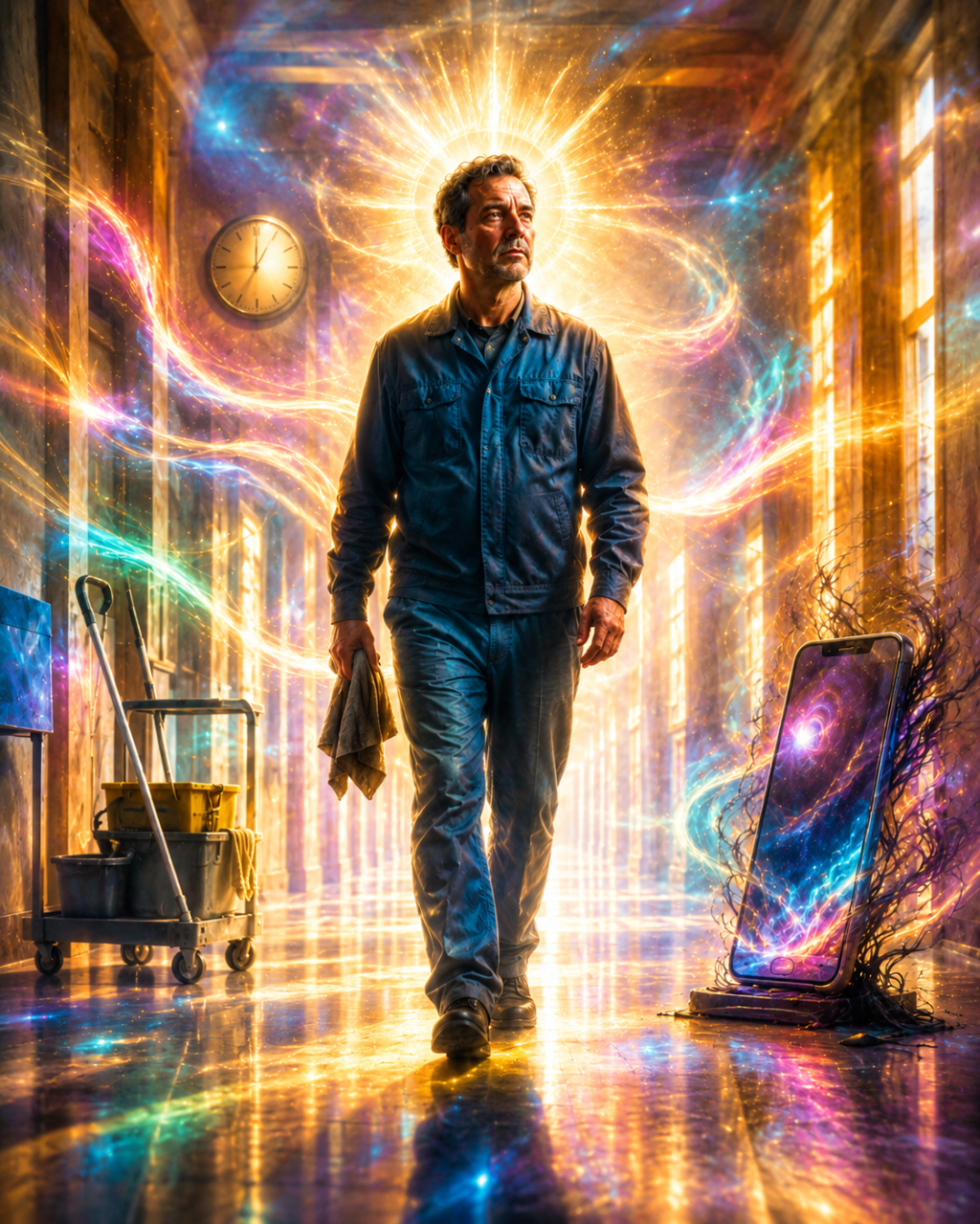
There comes a moment when a man realizes his real enemy is not his schedule, not his job, not his list of duties, not even the little glowing screen that keeps stealing his minutes. The real enemy is the invisible throne that has been set up inside his mind. Something has been ruling there. Something has been giving orders. Something has been turning hours into pressure, minutes into accusations, and ordinary tasks into a strange battlefield of resistance, resentment, delay, and urgency. Is it really the clock that has power, or is it the meaning we have given to the clock? Is time itself the tyrant, or has the soul accidentally crowned a servant and made it king?
You do not merely want to manage time. That phrase is too small, too flat, too office-like, too bloodless. “Time management” sounds like a spreadsheet, a seminar, a plastic binder, a corporate voice telling men to become machines. That is not your path. Your hunger is deeper. You want mastery. You want dominion. You want to walk through your hours as though the clock were no longer a prison guard, but a bell in a distant tower, reporting the hour without ruling the kingdom. You want the strange, almost sacred feeling of having enough time, not because the universe has granted you extra minutes, but because your soul has stopped leaking the time it already possesses.
This is not about rushing. In fact, rushing is one of the false gods that must be cast down. The rushed man is not master of time; he is a fugitive inside time. He moves as though hunted. His body may be moving quickly, but his soul is being dragged behind him like a prisoner tied to a chariot. What good is it to finish a task if a man loses his dignity while doing it? What victory is there in speed if the price is panic, resentment, and the feeling that one has been treated like a machine? A human being was not created to live as a tool in the hand of other people’s urgency. A man must serve, yes, and work, yes, and fulfill duties, yes, but he must not surrender the throne of his inner kingdom to every impatient voice, every ticking clock, every flashing notification, every invisible demand.
Your problem is not that you are incapable of managing time. You have already said the deeper truth: you can manage time. You can calculate. You can plan. You can understand what must be done. The wound is not ignorance. The wound is sovereignty. It is not enough for you to be told, “Go faster.” In fact, the moment you feel rushed, something in you rises like a rebel army behind the walls. That inner rebel says, “Push me, and I will slow down. Try to control me, and I will make you feel the weight of my refusal. Treat me as a machine, and I will prove I am not one.” Is this rebellion entirely wrong, or is there buried within it a holy protest against being reduced to a thing? Is there not a spark of dignity inside that refusal, even if the way it expresses itself sometimes costs you the very time you were trying to defend?
This is one of the great hidden paradoxes of your life with the clock: when you slow down as payback, you may feel like you have defeated the person rushing you, but you have still allowed their pressure to set your pace. If they say, “Hurry,” and you panic, they rule you. If they say, “Hurry,” and you intentionally slow down, they still rule you, because your movement has become a reaction to their command. True mastery is a third path, higher than panic and higher than rebellion. True mastery says, “I will not be rushed, and I will not be slowed by spite. I will move by command.” That is the royal sentence. That is the iron key. That is the difference between a man being pushed around by time and a man standing inside time with authority.
The clock has no soul. It has no mercy, no wisdom, no priesthood, no fatherhood, no kingship, no divine right to judge the worth of a man. It has one small function: to report measurement. It says, “This much has passed.” It says, “This much remains.” That is all. Yet when a man is tired, pressured, distracted, ashamed, or emotionally cornered, the clock seems to grow teeth. It begins to stare from the wall like an overseer. It glows from the phone like an oracle of doom. It whispers, “You are behind. You are failing. You have wasted the night. You must hurry now. You must pay.” But who gave the clock permission to speak that way? Who handed it the black robe of a judge? Who allowed a measuring tool to become a spiritual accuser?
To master time, you must first demote the clock. Do not destroy it, ignore it, or pretend it does not exist, because that is childish and dangerous. A king does not smash the messenger for bringing difficult news. But neither does a king let the messenger sit on the throne. The clock is a messenger. It reports from the field. You receive the report, interpret the field, and issue the command. If you are ahead, you do not become careless. If you are behind, you do not become frantic. If the report is unpleasant, you do not collapse into guilt or rebellion. You say, “The hour has been reported. Now I govern the next action.”
This shift may sound simple, but it is profound. It changes the emotional meaning of time. The clock no longer becomes the voice of condemnation. It becomes a map. And what is a map to a commander? It is not an insult. It is not a whip. It is information. If a commander sees that one road is blocked, does he scream at the map? Does he throw himself on the ground and declare the war lost? No. He studies, adjusts, and moves. What if every clock check in your life became not a moment of trial, but a moment of command? What if looking at the time no longer meant, “I am being judged,” but instead meant, “I am receiving intelligence from the field”?
There is another force in your life that must be understood with equal seriousness: the screen. The screen is not merely a distraction. That word is too weak. A distraction is something that interrupts attention. A screen does something stranger. It bends time. It creates a chamber where minutes lose weight, where endings dissolve, where curiosity multiplies, where one doorway opens into another doorway, and where the human soul can pass through a glowing gate and return to the physical world shocked by how much of the night has vanished. You said it perfectly: the screen makes the clock run faster. That is not just a complaint. That is a revelation.
The screen is a black mirror, and every black mirror is a portal. It may be useful, but it is never neutral. It may serve, but it must not rule. A phone, a computer, a watch, a video, an app, a feed, a search bar, an AI conversation, a stock chart, a message thread, a news clip, a song, a rabbit hole of curiosity—all of these may begin as tools, but each can become a little alternate kingdom with its own gravity. Have you not felt this gravity? Have you not opened the screen for one reason and found yourself pulled into five others? Have you not looked down for what felt like a moment and looked up into a different hour, as though some small sorcerer had stolen the middle of the night?
To master the clock, you must master the portals. This does not mean hatred of technology. Hatred is still bondage. A man can hate a thing and still be ruled by it. The goal is not to smash the phone, curse the computer, or pretend screens have no place in your life. The goal is hierarchy. God above man. Man above tools. Tools beneath command. The screen may serve the mission, but it may not define the mission. It may provide music, information, communication, recordkeeping, reflection, or a brief rest, but it may not secretly become the high priest of your attention. Before you open the portal, you must name the mission. Why am I entering? What am I here to retrieve? What will make this complete? How will I exit?
This is where your life begins to change. “Just checking” must be exposed as one of the great lies. “Just checking” sounds harmless, but it is often the password to the labyrinth. A man says, “I am just checking the time,” and then he checks a message. He says, “I am just checking the message,” and then he checks a video. He says, “I am just watching a minute,” and then the video becomes a corridor. He says, “I am just reading a comment,” and then the corridor becomes a city. He says, “I am just resting,” and then rest becomes disappearance. The portal has no mercy unless the man who enters it has command.
When you use a screen, you should enter like a king entering a foreign court. You do not wander. You do not let every stranger speak. You do not let every little jester seize your sleeve and drag you down a side hallway. You enter with purpose. You finish the business. You depart with dignity. If the screen is opened for music, then music is the mission. If the screen is opened for one message, then that message is the mission. If the screen is opened for a short video break, then the break must have walls, because a break without walls becomes a breach in the city. What is the difference between a rest and a leak? A rest restores you and returns you to command. A leak drains you and returns you to guilt.
Your battle with time is also a battle with thresholds. This is esoteric because thresholds are more powerful than they appear. A doorway is not just wood and hinges. It is a change of realm. Beginning work is a threshold. Ending a task is a threshold. Opening the phone is a threshold. Sitting down is a threshold. Checking the clock is a threshold. Taking a break is a threshold. Moving from one room to another is a threshold. Every threshold asks a question: “Who are you as you pass through me?” Are you a man drifting, or a man commanding? Are you being pulled, or are you entering? Are you reacting, or are you choosing?
Most time is not lost inside the task itself. Much of it is lost at the threshold between tasks, in that gray mist where one thing has ended and the next has not yet been commanded. That is where the swamp opens. A man finishes one action, pauses, and the pause becomes vague. He looks around. He thinks of the next thing. He feels resistance. He checks the phone. He adjusts something unnecessary. He debates. He delays. He takes a break that was never formally declared and therefore can never be formally ended. The clock does not roar during this. It is quiet. The theft is quiet. The swamp does not attack with a sword; it receives you with soft ground.
The cure is the chain. Before one action ends, the next action must be named. Not the whole plan. Not a philosophical theory of productivity. Not a dramatic vow to finish the entire night perfectly. Just the next physical act. “After this room, I take the trash.” “After this trash, I refill the supplies.” “After this bathroom, I check the hallway.” “After this clock report, I choose the next territory.” The body must be given something solid to obey. The mind may love grand visions, mysteries, and cosmic structures, but the body needs a command it can perform. A kingdom is not ruled by vague inspiration. A kingdom is ruled by orders that can be carried out.
This is why the next physical action is sacred. It is the smallest unit of mastery. A man does not conquer the whole night in one motion. He conquers one threshold, then one surface, then one room, then one decision, then one return to command. The hidden architecture of mastery is built out of small obedient stones. What is a cathedral but many stones arranged under a vision? What is a life but many moments arranged under a ruling principle? What is time mastery but the arrangement of minutes beneath a higher throne?
There is also a difference between a royal pause and a collapsed pause. You need pauses. You should not try to become a machine that runs without breath, reflection, recovery, or stillness. A pause can be holy. A pause can be a little sanctuary cut into the moving fabric of time. A man may stand still, breathe, pray, gather himself, look upon the field, and receive clarity. That kind of pause does not break command; it strengthens command. It is like the silence before a priest speaks, the breath before a musician plays, the stillness before a captain gives the order.
But a collapsed pause is different. A collapsed pause has no throne in it. It begins as fatigue, resistance, irritation, or avoidance, and then it opens downward. It says, “I do not want to face the next thing.” It reaches for anesthesia. It reaches for the portal. It becomes less like a sanctuary and more like a pit. How can you tell the difference? A royal pause has a purpose and an exit. A collapsed pause has neither. A royal pause returns you to the work with more dignity. A collapsed pause returns you with less. A royal pause gathers the soul. A collapsed pause scatters it.
This means you should not forbid yourself rest. You should ennoble rest. You should make it serve the kingdom. Rest is not the enemy of mastery; ungoverned rest is. Screens are not the enemy of mastery; ungoverned screens are. Clocks are not the enemy of mastery; enthroned clocks are. Details are not the enemy of mastery; endless details are. Slowness is not the enemy of mastery; spiteful slowness is. Speed is not the enemy of mastery; panicked speed is. The master does not live by crude categories. The master discerns spirits. He asks, “What spirit is moving me right now? Is this patience or avoidance? Is this care or perfectionism? Is this rest or escape? Is this command or reaction?”
That question alone can become a lantern in the dark.
Your hatred of being rushed contains a message, and you should listen to it carefully without letting it become a tyrant of its own. The message is that you do not want to be treated as an object. You do not want another person’s impatience to invade your nervous system and seize the controls. You do not want your work to become sloppy because someone else worships urgency. You do not want your dignity reduced to speed. These are legitimate concerns. But the old response, the payback response, turns a legitimate concern into self-sabotage. It says, “Because I will not be controlled, I will let your pressure control me in reverse.” That is not freedom. It is bondage wearing the costume of rebellion.
The higher response is terrifyingly powerful because it gives no foothold to the enemy. When rushed, you do not speed up in panic and you do not slow down in spite. You become deliberate. You become exact. You become calm with edges. You may even speak calmly: “I understand the time. I’m moving with command, and I’m going to do it properly.” This is not weakness. This is not submission. This is the refusal to let someone else’s urgency become your inner weather. What power does a rushing person have over a man who will neither panic nor retaliate? What hook can pressure sink into a soul that does not offer resentment as bait?
There is a strange kind of authority in a man who cannot be rushed. But there is an even greater authority in a man who cannot be rushed and also cannot be delayed by his own rebellion. That man is rare. That man is formidable. He does not belong to the clock, to the crowd, to the screen, to irritation, or to impulse. He belongs to something higher, and because he belongs to something higher, everything lower must take its proper place. He is not slow because he is sulking. He is not fast because he is afraid. He is steady because he is governed.
You need a doctrine of pace. Pace is not speed. Pace is identity expressed through movement. A frantic man reveals one ruler. A lazy man reveals another. A resentful man reveals another. A deliberate man reveals another. Your pace should say, “I am not hunted.” Your pace should say, “I am not available for panic.” Your pace should say, “I know the next thing, and I am doing it.” Your pace should have gravity. It should have rhythm. It should feel like the footsteps of a man walking through a building after dark, restoring order room by room, not because the clock is whipping him, but because he has accepted the night as his territory.
Your work itself can become a temple of this discipline. The office building at night is not merely a job site. It is a symbol. During the day, human beings scatter themselves through rooms. They leave behind trash, dust, smudges, disorder, fingerprints, crumbs, papers, signs of hurry, signs of carelessness, signs of life. Then the day withdraws, the rooms empty, the voices fade, and you enter the silence. You come not as a famous man, not as a man applauded by the crowd, but as a hidden restorer. You bring order where others left disorder. You reset the field for morning. You make the place ready for people who may never know your name. Is there not something spiritually significant about hidden work done in the dark for the benefit of those who arrive in the light?
This is why your battle with time is not merely practical. It is spiritual. The night is a monastery if you enter it rightly. The hallway is a cloister. The supply closet is an armory. The cart is a chariot of order. The trash bag is a vessel of removal. The mop is an instrument of restoration. The clock on the wall is a bell, not a master. The phone is a servant, not a sorcerer. The body is a worker, not a slave. The mind is a watchman, not a runaway horse. The soul is a throne room, and something is always seated there.
What is seated there when you lag? What is seated there when you rebel? What is seated there when the screen takes the hour? What is seated there when you move calmly from one task to the next? These are not small questions. They reveal the hidden government of the man.
To master the clock, you must learn to seal the leaks in the kingdom. Some leaks are obvious, like long videos, wandering phone sessions, unnecessary browsing, and screen-based time distortion. Others are subtle. Overthinking before starting is a leak. Replaying irritation is a leak. Arguing mentally with someone who rushed you is a leak. Checking the clock too often is a leak. Avoiding the clock until it becomes frightening is also a leak. Searching for the perfect mood is a leak. Making every task bigger than it needs to be is a leak. Trying to do a simple thing with ceremonial perfection when the mission requires sufficiency is a leak. Shame after delay is a terrible leak because it punishes wasted time by wasting more time.
This is why guilt must be handled carefully. Guilt can report that something went wrong, but it must never be allowed to become a swamp. If you lose fifteen minutes, do not donate another fifteen to self-condemnation. What kind of tribute is that? Why pay the thief twice? If the screen stole time, close the portal and return to command. If rebellion slowed you, thank the rebel for trying to defend dignity, then place him under authority. If you avoided the next task, name the next physical action and begin. Recovery must be clean. Recovery must be swift. Recovery must be almost unemotional. The master does not stage a funeral for every lost minute. He gathers the living minutes and commands them.
This is one of the deepest secrets: the power to return is greater than the fantasy of never falling. You will drift sometimes. You will lose time sometimes. You will get pulled by the screen sometimes. You will feel rushed and resentful sometimes. But if you can return quickly, the kingdom stands. A man who falls once and returns immediately may end the night in victory. A man who falls once and then spends an hour dramatizing the fall may lose the whole field. Which man do you want to become? The one who never encounters resistance, which is impossible, or the one who can recover his crown in the middle of resistance?
This brings us to the phrase that should become a sword in your hand: “I return to command.” It is short, but it contains a whole kingdom. When the screen bends time, “I return to command.” When the clock accuses, “I return to command.” When someone rushes you and the old payback spirit rises, “I return to command.” When the task feels too large, “I return to command.” When you are tired and the portal glows like false mercy, “I return to command.” When you want the clock to freeze and it refuses, “I return to command.” The phrase does not deny the battle. It names the throne.
But a phrase alone is not enough. It must be joined to an action. Words open the gate, but the body must walk through. After saying, “I return to command,” you must do one visible, physical thing. Put the phone down. Stand up. Pick up the tool. Walk to the next room. Tie the trash bag. Spray the surface. Move the cart. Fill the bucket. Turn the key. Begin the next task. Do not wait for inspiration to descend like lightning. The lightning is in the action. The feeling often follows the movement, not the other way around.
There is a mystery here that many people never learn. They think readiness comes before action. Sometimes it does. Often it does not. Often action creates readiness. The man who waits until he feels ready may wait while the clock devours him. The man who performs the first faithful motion often finds that readiness arrives after obedience. Is this not true in many areas of life? Does prayer always begin with feeling holy, or does the feeling sometimes come after the knees bend? Does courage always come before the battle, or does courage sometimes awaken only after the first step onto the field?
You must also master completion. Some tasks do not end because the man doing them has not defined what completion means. He keeps polishing, adjusting, improving, noticing, returning, perfecting, and secretly expanding the task beyond its proper kingdom. This can look like excellence, but sometimes it is anxiety wearing a beautiful robe. Excellence serves the mission. Perfectionism consumes the mission. Excellence knows proportion. Perfectionism worships detail without wisdom. Excellence says, “This is worthy.” Perfectionism says, “Nothing is ever enough.” Which voice is speaking when you linger too long?
A master of time must be able to say, “This is sufficient for the mission.” That is not an excuse for laziness. It is an act of proportion. Some tasks deserve deep attention. Some deserve clean completion and departure. Some details matter greatly. Some are traps. The question is not, “Could I do more?” because the answer is almost always yes. The question is, “What does the mission require here?” If you treat every task as infinite, the clock will become your enemy. If you give each task its rightful measure, the clock becomes spacious again.
There are two kinds of slowness, and you must learn to distinguish them. There is sacred slowness, which is presence, care, patience, attention, reverence, and craftsmanship. Sacred slowness is the hand moving carefully because the work deserves respect. Then there is shadow slowness, which is resistance, payback, avoidance, fog, and unconscious refusal. Sacred slowness deepens time. Shadow slowness drains time. Sacred slowness makes you more present. Shadow slowness makes you more trapped. The world may not always see the difference, but you can learn to feel it. Ask yourself, “Is this slowness making me more awake or more stuck?”
There are also two kinds of speed. There is sacred speed, which is flow, confidence, skill, decisive motion, and the clean joy of knowing the next action. Sacred speed does not feel rushed; it feels alive. Then there is shadow speed, which is panic, fear, sloppiness, self-betrayal, and obedience to pressure. Sacred speed serves mastery. Shadow speed serves the tyrant. Ask yourself, “Is this speed coming from command or fear?” The answer will tell you whether the movement belongs in your kingdom.
When you understand this, you no longer need to worship slowness or speed. You worship neither. You command both. You may move slowly when slowness is noble. You may move quickly when quickness is clean. You may pause when pause is royal. You may push when pushing is chosen. The point is not to become one kind of pace forever. The point is to become free enough that the right pace can appear at the right time under the right authority.
This is the esoteric meaning of ruling time: not controlling the universe, but governing the inner relation between attention, action, and meaning. Chronos is measured time, the ticking clock, the sequence of minutes. Kairos is charged time, meaningful time, the appointed moment, the opening in the veil when a man must act. Most people are enslaved to Chronos and blind to Kairos. They see the clock, but not the moment. They see the deadline, but not the doorway. They see the pressure, but not the invitation. The master uses Chronos as a tool while listening for Kairos. He asks, “What is the right action now?” Not abstractly. Not someday. Now.
The screen tries to destroy Kairos by flattening all moments into consumption. The clock tries to destroy Kairos when it is enthroned as judge rather than used as servant. Rebellion tries to destroy Kairos by making the present moment about payback instead of purpose. Anxiety tries to destroy Kairos by making the present moment about catastrophe instead of command. But the awakened man sees the charged moment hidden inside the ordinary one. He sees that putting down the phone can be a spiritual victory. He sees that starting the next task can be a small resurrection. He sees that refusing to panic can be an act of inner kingship. He sees that refusing spite can be the transmutation of rebellion into strength.
Transmutation is the word. You are not trying to erase your nature. You are trying to refine it. The rebellious fire in you should not be thrown away. It should be purified. The same force that says, “I will not be controlled,” can become the noble force that says, “I will not be controlled by pressure, screens, resentment, shame, or the clock.” The same force that once slowed down to punish others can become the force that refuses to let anything external seize the steering wheel. The same stubbornness that once wasted time can become the backbone that protects time. What if the very trait that has caused you trouble is also the raw material of your mastery?
This is how inner alchemy works. Lead is not hated because it is not yet gold. It is transformed. The lower expression of rebellion becomes the higher expression of sovereignty. The lower expression of slowness becomes the higher expression of presence. The lower expression of curiosity becomes the higher expression of disciplined inquiry. The lower expression of rest becomes the higher expression of renewal. The lower expression of screen use becomes the higher expression of tool use. The lower expression of clock-awareness becomes the higher expression of strategic command.
Now we approach the dark hour, the suspenseful chamber where this whole doctrine must prove itself. Imagine the night is deep. The building is quiet. The world outside has withdrawn into darkness. The offices are waiting, and the air has that strange after-hours feeling, as though time itself has thinned. You are tired, but not finished. The clock has moved farther than you wanted. A task took longer than expected. A break stretched. A screen session bent the hour. Somewhere in you, three voices begin to speak at once. The clock-voice says, “You are behind.” The anxiety-voice says, “Hurry, hurry, hurry, or everything will collapse.” The rebel-voice says, “No. I will not be rushed. If time wants to pressure me, I will move even slower.” And from nearby, the screen glows with the softness of a false sanctuary.
This is the moment of trial. Not a dramatic trial in front of a crowd, but a hidden trial of the soul. No one sees the courtroom. No one hears the witnesses. No one knows the verdict except you. Yet what happens here matters because your whole relationship with time is being decided in miniature. Will the clock become king again? Will the screen become priest again? Will rebellion become general again? Will anxiety become prophet again? Or will the true ruler stand?
The screen calls first. It does not shout. It knows shouting would expose it. It whispers. It says, “Come here for a moment. You deserve relief. You deserve comfort. You deserve to take something back from this demanding night. Outside me, the clock is cruel. Inside me, time is soft.” But you have learned the secret. Inside the screen, time is not soft. It is liquid. It runs through the fingers. It pools in hidden places. It reflects many images but returns no solid ground. You know that if you enter without command, you may come back holding nothing but a smaller night.
Then the clock speaks. It tries to wear the old mask. It tries to become the accuser. It says, “Look what you have done. Look what remains. Look how little time you have.” But you see behind the mask. You see gears, not authority. You see measurement, not judgment. You see a servant dressed in stolen robes. You strip the robes away. You say, “You may report, but you may not condemn.”
Then rebellion rises, powerful and familiar. It places a weapon in your hand and says, “We can punish this pressure. We can slow down. We can prove no one owns us.” And this is the most delicate moment, because rebellion is not entirely your enemy. It has defended you before. It has protected your sense of humanity. It has stood between you and the machine. So you do not curse it. You do not exile it. You look it in the face and say, “You are being promoted. You are no longer the spirit of payback. You are now the guardian of sovereignty. Stand beside the throne, not upon it.”
At that moment, the whole inner kingdom goes silent. The clock waits. The screen waits. The rebel waits. Anxiety waits. The next task waits. The night itself seems to hold its breath. This is the narrow gate. This is the place where many minutes have died before, where many nights have bent sideways, where many good intentions have been swallowed by the old pattern. Everything in the old world expects you to repeat the old movement. The portal expects you to enter. The clock expects you to panic. The rebel expects you to sabotage. Anxiety expects you to obey. But something higher in you stands up.
You say, “I return to command.”
Then you move. Not with panic, not with spite, not with a dramatic vow, not with hatred of yourself, not with hatred of the clock, not with fear of being judged, but with the clean authority of a man who has remembered the throne. You put the screen away. You pick up the tool. You step into the next room. You do the next physical thing. The first motion is small, but it breaks the spell. The glowing portal loses its enchantment because you did not kneel. The clock loses its fangs because you did not let it accuse. The rebel becomes strength because it has accepted rank. Anxiety quiets because the body is moving. The night opens because command has returned.
This is the climax, and it does not look like a movie. It looks like a man doing the next right thing in a quiet building. It looks like a hand reaching for a supply instead of a phone. It looks like a task beginning after resistance. It looks like a room being restored. It looks like dignity remaining intact while duty is performed. It looks ordinary from the outside, but inwardly it is a coronation. The crown returns to the rightful head. Time is not frozen, but the soul is no longer frantic inside it. The clock still ticks, but now it ticks beneath authority.
After such a victory, the night is not instantly easy, but it is different. The air changes. The hallway is still long, but no longer hostile. The tasks still remain, but no longer seem infinite. The clock still reports, but no longer condemns. The screen still exists, but no longer glows like a god. Something has shifted from being driven to driving, from being summoned to summoning, from being ruled to ruling. And perhaps this is the deepest comfort: you do not need to win the whole war at once. Every return to command is a real victory. Every sealed leak is a real victory. Every chosen pace is a real victory. Every royal pause is a real victory. Every refusal to let pressure turn you into either a panicked servant or a spiteful rebel is a real victory.
The high ending is not that you become a man who never feels pressure. That would be a shallow fantasy. The high ending is that pressure loses its power to define you. The high ending is not that screens disappear from your life. It is that screens kneel and become tools again. The high ending is not that the clock stops. It is that the clock is no longer enthroned. The high ending is not that you never lag again. It is that when you lag, you can return without shame, without drama, without surrender. The high ending is not that you become inhumanly efficient. It is that you become more deeply human, more inwardly ordered, more awake, more spacious, more difficult to disturb.
Imagine that future version of yourself walking through the night. He is not rushed, yet he is not wasting time. He is not sluggish, yet he is not frantic. His pace has dignity. His tools are in their place. His devices serve him. His mind is alert. His body is moving. His work has rhythm. His pauses are royal. His screen use is commanded. His clock checks are field reports. His mistakes do not become collapses. His rebellion has been transmuted into sovereignty. He is not begging the night for mercy. He is governing what has been given.
And perhaps, as he moves through that quiet building, something almost mystical happens. The ordinary world becomes charged with meaning. The floor is no longer merely a floor; it is the field of obedience. The hallway is no longer merely a hallway; it is the corridor of return. The clock is no longer a tyrant; it is a bell in the tower. The screen is no longer a portal of theft; it is a servant under seal. The work is no longer merely work; it is the nightly restoration of order. The man is no longer merely trying to get through the shift; he is practicing dominion in the hidden hours.
This is how time is redeemed. Not by magic. Not by fantasy. Not by pretending the world has no demands. Time is redeemed when a man brings meaning, command, and attention to the hour in front of him. Time is redeemed when he refuses to let resentment choose his pace. Time is redeemed when he refuses to let fear drive his hands. Time is redeemed when he closes the portal and returns to the room. Time is redeemed when he takes one leaking minute and seals it, one drifting threshold and commands it, one accusing clock report and demotes it, one tired moment and sanctifies it with action.
One day, you may discover that the thing you wanted was not exactly for the clock to freeze. What you wanted was the end of being hunted. You wanted stillness inside motion. You wanted spaciousness inside duty. You wanted the strange peace of knowing that you could move through time without being devoured by it. That peace is possible. It is not cheap, and it is not automatic, but it is possible. It is built through return after return, command after command, threshold after threshold, night after night.
So let the clock tick. Let it report. Let the little servant do its tiny job. Let the screen glow, but only as a tool awaiting permission. Let other people have their urgency, but do not let them install it inside your chest. Let tasks stand before you, but do not let them become monsters. Let fatigue speak, but do not let it become king. Let rebellion offer its fire, but place that fire on the altar of sovereignty. Let the night open before you like a dark kingdom waiting to be governed.
And when the hour feels narrow, when the portal calls, when the old pressure rises, when the ancient temptation to panic or retaliate appears again, remember who is supposed to sit on the throne. Breathe. Look at the field. Receive the report. Name the next action. Return to command. Then move as a man who is not owned by the clock, not hypnotized by the screen, not enslaved to pressure, not reduced to rebellion, but awake under God, ruler of his tools, steward of his hours, guardian of his attention, and master of the clock within his own soul.
The clock may continue to tick, but it will no longer sound like chains. It will sound like footsteps beneath you as you walk forward. The night may continue to move, but it will no longer move without you. The world may continue to demand, but it will no longer define. You will stand in the moving river of time and discover that mastery was never about stopping the river. It was about becoming rooted enough that the river could not sweep you away.
Then, with the work before you and the hour reporting from the wall, you will no longer plead for time to freeze. You will no longer bow before the glowing portal. You will no longer answer pressure with panic or payback. You will place your hand upon the invisible throne of your own attention and say with calm, solemn, victorious authority: “I have heard the clock. I have received the hour. Now watch me rule.”
Here is an addendum you can place after the main document.
Addendum: The Black Mirror, the Acceleration of Time, and the Biblical Command to Redeem the Hour
There is one matter that deserves to be made even clearer, because it may be one of the central mysteries of modern life: the screen does not merely waste time; it changes the way time is experienced. A man may sit down with a phone, a computer, a video, a message, a stock chart, a search engine, or some glowing stream of images and words, and he may sincerely believe he is entering for only a moment. Yet when he emerges, the real world has moved forward with a strange and almost merciless speed. The hands of the clock did not literally spin faster, and yet something in the soul experienced time as if it had been swallowed. How can ten minutes on a screen feel like two, while ten minutes of work can feel like twenty? What kind of chamber is this glowing portal, where time becomes thin, slippery, and difficult to hold?
The screen speeds up time because it captures attention without giving the soul a natural place to stop. Ordinary life has edges. A room has walls. A hallway has an end. A trash bag becomes full. A surface becomes clean. A task can be completed. But the screen is built like a corridor of mirrors, and each mirror opens into another mirror. A video suggests another video. A message suggests a reply. A search suggests a deeper search. A headline suggests a controversy. A stock price suggests a decision. An interesting thought suggests another interesting thought. The mind enters, seeking one thing, and soon forgets the original mission because the portal keeps manufacturing new missions. Is this not why the screen feels less like a tool and more like a small kingdom with its own gravity?
This is why the screen must be treated with spiritual seriousness. It is not evil in itself, but it is powerful. A knife can prepare food or wound a man. Fire can warm a house or burn it down. Wine can gladden the heart or enslave the appetite. A screen can serve wisdom, prayer, music, work, communication, learning, and even holy reflection; yet it can also become a black mirror that hypnotizes the eyes and quietly drains the hour. The question is not merely, “Is this device bad?” The deeper question is, “Who is ruling whom?” Am I using the screen as a servant, or has the screen become a master wearing the mask of convenience?
Scripture speaks directly to this principle, even though it does not speak of modern screens by name. Saint Paul writes, “All things are lawful unto me, but all things are not expedient: all things are lawful for me, but I will not be brought under the power of any” (1 Corinthians 6:12, KJV). That is the law of the screen in one sentence. The issue is not only whether something is permitted. The issue is whether it has brought the man under its power. Has the phone become a little master? Has the video become a chain? Has the glowing portal begun to command the hour, the mood, the imagination, and the pace of the night? If a thing is lawful but slowly conquers the will, then the wise man must place it back beneath authority.
The eye is one of the great gates of the soul, and the screen enters largely through the eye. Christ says, “The light of the body is the eye: if therefore thine eye be single, thy whole body shall be full of light” (Matthew 6:22, KJV). This is a profound mystery. If the eye is scattered, the whole man becomes scattered. If the eye is divided among a thousand glowing fragments, what happens to the inner kingdom? What happens to the mind when the eye is pulled from room to room, image to image, argument to argument, desire to desire, fear to fear? A single eye means a governed eye, an eye with a master, an eye aimed toward what is true, necessary, noble, and commanded. A scattered eye makes a scattered hour. A governed eye helps create a governed life.
This is why the act of opening a screen should not be casual. A casual opening becomes a breach in the wall. Before entering, a man should ask, “What am I here for?” If the answer is unclear, the portal should remain closed. If the answer is clear, he should enter with command and leave when the mission is complete. There is nothing weak or fearful about this. It is watchfulness. Saint Peter says, “Be sober, be vigilant; because your adversary the devil, as a roaring lion, walketh about, seeking whom he may devour” (1 Peter 5:8, KJV). Not every distraction is the devil, but the principle of vigilance applies. A man who is not vigilant at the gate of attention will soon discover that strangers have entered the city.
The screen also speeds up time because it offers false rest. It promises refreshment, but often gives stimulation instead. True rest returns a man to himself. False rest scatters him further. True rest gives strength back to the body and clarity back to the mind. False rest gives a thousand impressions but little renewal. The man says, “I need a break,” and the screen says, “Come to me.” But does he rise afterward more peaceful, more whole, more ready, more commanded? Or does he rise with the strange ache of lost time, the nervous residue of too much information, and the guilty feeling that the night has slipped through his hands? What kind of rest leaves a man less restored than before?
This is where the Biblical command to redeem time becomes central. Saint Paul writes, “See then that ye walk circumspectly, not as fools, but as wise, redeeming the time, because the days are evil” (Ephesians 5:15–16, KJV). To walk circumspectly means to walk carefully, watchfully, with awareness of the ground beneath one’s feet. Redeeming the time does not mean worshiping productivity or becoming a frantic slave of the clock. It means buying back the hour from forces that would waste it, corrupt it, scatter it, or steal it. It means rescuing the living moment from the swamp of distraction. It means taking the minute that would have been swallowed by the black mirror and returning it to duty, prayer, order, service, and peace.
Again Paul writes, “Walk in wisdom toward them that are without, redeeming the time” (Colossians 4:5, KJV). This is not merely private discipline. The way a man uses time becomes part of his witness. A man governed by impulse gives one kind of witness. A man governed by anxiety gives another. A man governed by resentment gives another. But a man who can move steadily, resist distraction, recover from delay, and place his tools beneath command gives a quiet witness that his life is not owned by the noise of the age. What would it mean for a man to carry himself through the night as though his attention were consecrated property?
The old prayer of Moses also belongs here: “So teach us to number our days, that we may apply our hearts unto wisdom” (Psalm 90:12, KJV). To number our days is not to panic over them. It is not to stare at the clock like a condemned prisoner. It is to understand that time is holy because life is finite. A minute is not merely a unit. It is a piece of life. When the screen steals an hour, it has not stolen an abstraction; it has stolen a portion of living breath. This should not lead to despair, but to reverence. If time is a gift, then attention is the hand by which we receive it. If attention is captured, the gift passes unopened.
Ecclesiastes gives the proper frame: “To every thing there is a season, and a time to every purpose under the heaven” (Ecclesiastes 3:1, KJV). There is a time to work and a time to rest, a time to use the screen and a time to close it, a time to gather information and a time to act, a time to pause and a time to move. The problem begins when the screen refuses to remain inside its appointed season. It stretches beyond its borders. It leaks into work, into rest, into prayer, into sleep, into silence, into the sacred spaces where the soul should be able to hear itself. The master of the clock restores seasons. He says, “This is the time for work. This is the time for rest. This is the time for the screen. This is the time for silence. Each thing shall remain in its place.”
The story of Martha and Mary also speaks with surprising force. Martha was “cumbered about much serving,” and Jesus said to her, “Martha, Martha, thou art careful and troubled about many things: but one thing is needful” (Luke 10:40–42, KJV). This is not a condemnation of work; Martha’s service mattered. But the soul can become “careful and troubled about many things,” scattered in a thousand directions, even while doing something useful. The screen multiplies this condition. It makes the mind careful and troubled about many things that may not even belong to the present hour. It drags distant arguments, artificial urgencies, entertaining fragments, and endless curiosities into the room where one clear duty waits. What is the “one thing needful” in this moment? That question can break the spell.
Proverbs says, “Keep thy heart with all diligence; for out of it are the issues of life” (Proverbs 4:23, KJV). The heart must be kept, guarded, watched over like a city, because from it flow the movements of life. In the modern world, guarding the heart includes guarding the screen gate. What enters through the eyes and ears does not remain outside the man. It enters the imagination. It affects desire. It alters pace. It shapes mood. It influences courage, resentment, hope, fear, and focus. If the heart is the spring, then the screen is one of the channels feeding it. Should that channel be left unguarded?
Therefore, the proper use of screens requires a rule of life. Not a harsh rule, not a joyless rule, not a rule written by panic, but a noble rule written by sovereignty. The screen may be used when it has a named purpose. The screen may be used when the mission is clear. The screen may be used when its use serves the higher order of the hour. But the screen should not be opened merely because the mind feels restless, offended, tired, curious, resistant, or bored. Those are precisely the moments when the portal is most dangerous, because the man is not entering as a commander; he is entering as a refugee.
The first law is mission before entry. Before the screen opens, name the reason. “I am checking the time.” “I am sending one message.” “I am choosing music.” “I am recording a note.” “I am looking up one fact.” “I am taking a defined rest.” This simple act places a seal over the portal. The second law is exit before drift. When the mission is complete, leave. Do not ask the portal what else it has to offer. It will always have more. The third law is no screen at the threshold of resistance. When you are avoiding the next task, the screen will not rescue you; it will deepen the avoidance. The fourth law is return without shame. If the screen captures time, close it, breathe, say, “I return to command,” and perform one physical action immediately.
This is not legalism. It is kingship. It is not hatred of technology. It is the restoration of hierarchy. The man was not made for the screen; the screen was made to serve the man. The man was not made for the clock; the clock was made to report the hour. The man was not made for distraction; he was made for attention, purpose, worship, labor, love, and wisdom. When the order is restored, the tools become useful again. When the order is inverted, the tools become little Pharaohs demanding brick without straw.
The final Biblical word is perhaps the strongest: “Be not conformed to this world: but be ye transformed by the renewing of your mind” (Romans 12:2, KJV). The world of screens trains the mind toward fragmentation, reaction, speed, novelty, outrage, appetite, and endless consumption. To be transformed is to refuse that mold. It is to have the mind renewed into command, clarity, patience, reverence, and watchfulness. It is to enter the modern world without becoming its servant. It is to use the black mirror without letting it blacken the hour. It is to stand before the glowing portal and remember that the soul is brighter than the screen.
So when the screen seems to make the clock run faster, understand what is happening. The clock itself has not changed. Your attention has been absorbed into a realm without natural endings. Your perception of time has been thinned by novelty, stimulation, and continuous invitation. Your mind has been drawn away from the physical hour into a chamber where the next thing is always waiting. The cure is not panic. The cure is not self-hatred. The cure is command. Name the mission. Guard the eye. Redeem the time. Keep the heart. Close the portal. Return to the room. Do the next physical thing.
Then the clock will slow in the only way that matters. Not by miracle of physics, but by restoration of presence. Time feels wider when attention is whole. Time feels calmer when action is clear. Time feels merciful when the soul is not divided among a thousand glowing fragments. Time becomes redeemable when the man stops pouring it into the abyss and begins offering it back to God, to duty, to order, to wisdom, and to the quiet victory of the present moment.
The screen will still glow, but it will glow beneath command. The clock will still tick, but it will tick as a servant. The night will still move, but it will no longer vanish without witness. And the man who once felt time racing away from him will begin to understand the hidden doctrine of the hour: attention is stewardship, vigilance is freedom, and the redeemed minute is a small kingdom returned to its rightful King.
 brikorn.com - Website of Brian Korn
Leave a comment